

Quick answer: Seoul winters are cold and dry: the January average is about minus 5 C at night and 2 C in the afternoon, according to 1991 to 2020 normals. Dress in thin warm layers you can remove indoors, wear a windproof coat, and buy hot packs (핫팩) at convenience stores. Many indoor places are well heated, but snow can disrupt flights, especially on Jeju, so keep a buffer day.

What Korean winter actually feels like
Korean winter is cold and dry. In Seoul, the 1991 to 2020 normals from the Korea Meteorological Administration, as summarized by a secondary climate page, put the average December high around 4 C and the low around minus 3 C. January is colder, with an average high near 2 C and a low around minus 5 C. February is slightly warmer.
Those are averages, not promises. Individual days can be much colder when a cold wave arrives, and the wind makes the temperature feel lower. Sunshine is common in winter, but the days are short and the evenings arrive early.
| Month in Seoul | Typical high | Typical low |
|---|---|---|
| December | About 4 C | About minus 3 C |
| January | About 2 C | About minus 5 C |
| February | About 5 C | About minus 3 C |
Busan is usually milder, and Jeju is milder still, though both can feel cold in strong wind and rain. I did not find an official KMA table for those two cities, so check the KMA climate data before you plan packing for them. For a general view of the year, see our best time to visit Korea guide.

How to dress like you live here
The common advice from foreigners and from Koreans is the same: use layers. A thin warm base, a knit or fleece in the middle and a windproof coat on top. Study International, writing in February 2026 about a first Korean winter, recommends longer padded outerwear for the legs and wind, Heattech style base layers and hot packs from convenience stores.
- Wear a long padded coat if you will spend hours outside, such as at a festival, a palace or a market.
- Bring gloves, a scarf and a hat. Hands and neck lose heat quickly in dry wind.
- Choose waterproof shoes with good grip. Sidewalks can be icy, and many places ask you to remove shoes.
- Skip heavy cotton. Wet cotton from snow or sweat feels colder.
You can also buy winter gear in Korea. A padded coat or thermals are easy to find in shopping districts, so a visitor who packs light can shop on arrival. The Korea travel checklist covers the rest of the basics.
If you travel with children or older relatives, add a spare pair of gloves and a warm drink plan. Our Korea with kids guide also has notes on family trips.

Hot packs and small warmers
Hot packs, called 핫팩, are the quiet hero of Korean winters. They are sold at convenience stores such as CU and GS25 and at Daiso, and they are cheap enough that most people carry several. A resident blog from January 2026 says they warm up within about 30 seconds and last for most of a day.
There are two common types: pocket packs and stick-on packs. Put pocket packs in a coat or glove and use stick-on packs on clothing, not on skin. The same blog warns against direct skin contact because low temperature burns are possible.
If you need one in a hurry, walk into any convenience store and ask 핫팩 있어요? The word is easy to say and almost everyone understands it. Our convenience store guide explains the other things you can buy there.
Warm indoors, dry air and ondol
Indoors, Korea is often warmer than visitors expect. Many homes use ondol, an underfloor heating system, and public buildings are usually well heated. A Korea Times columnist, Jeffrey Miller, recalled in January 2026 how ondol warmed him from below even while the air in his first Seoul apartment stayed cold.
Not every place is the same. A resident blogger who lived in Suncheon wrote in 2023 that some hotels and traditional restaurants may not have conventional heaters, so ask when you book. If a room feels cold, 난방 좀 올려 주세요 is a polite way to ask for more heat.
The air is dry, so bring moisturizer and lip balm. A warm bath at a jjimjilbang can be a good break from the cold, and our jjimjilbang guide explains how it works.

Cold waves, snow and travel delays
Korea issues cold wave alerts when temperatures drop sharply. According to the Korea Meteorological Administration, a cold wave advisory (한파주의보) can be issued when the morning minimum falls by 10 C or more from the day before to 3 C or lower and is at least 3 C below the seasonal average, or when the minimum stays at minus 12 C or lower for two days. A warning (한파경보) uses stricter limits. The sudden drop matters as much as the absolute cold.
Snow is less frequent in Seoul but can still disrupt travel, and black ice can make walking and driving risky. Jeju is the clearest example for visitors: on February 8, 2026, heavy snow led to 163 of 461 flights being cancelled and left about 11,000 passengers stranded, according to The Star. If you are flying to or from Jeju in winter, keep a buffer day and use your airline app.
Winter also affects plans on the coast and in the mountains. Check conditions before long walks, and read our coastal walks guide and Seoul hiking guide for notes on daylight and weather. Holiday closures can also change your schedule, so see our holiday closures guide for Lunar New Year.
Winter food that helps
Korean winter food is practical. Hotteok, a sweet fried pancake, and roasted sweet potatoes are sold from street stalls. Hot soups and stews are common at restaurants. Jeffrey Miller also mentioned roasted sweet potatoes and bungeoppang as quick comforts in his Korea Times column.
A hot drink can also be a plan. Cafes are warm, and many visitors use them as a break between outdoor stops. Try 호떡 하나 주세요 at a stall and carry small change for cash only stalls.
Useful phrases
These phrases help with heat, hot packs and slippery streets.
| Korean | Pronunciation | Meaning |
|---|---|---|
| 핫팩 있어요? | hat-paek i-sseo-yo | Do you have hot packs? |
| 너무 추워요 | neo-mu chu-wo-yo | It is so cold |
| 따뜻한 물 주세요 | tta-tteut-han mul ju-se-yo | Warm water, please |
| 난방 좀 올려 주세요 | nan-bang jom ol-lyeo ju-se-yo | Please turn the heating up |
| 온돌방이에요? | on-dol-bang-i-e-yo | Is it an ondol room? |
| 길이 미끄러워요 | gi-ri mi-kkeu-reo-wo-yo | The road is slippery |
| 호떡 하나 주세요 | ho-tteok ha-na ju-se-yo | One hotteok, please |
Search word for your map app: 핫팩, or 편의점 to find the nearest convenience store.

What visitors report
Several visitors and residents have written about Korean winters, and the same themes repeat. These are individual experiences, not statistics.
- Emily Mar, writing for Study International in February 2026 about an eight day trip, repacked after an extreme cold forecast. She recommends longer padded outerwear, Heattech base layers and convenience store hot packs.
- A writer on the Living and Working Korea Guide blog, in January 2026, arrived with thin gloves and a light jacket and found commutes miserable until she discovered 핫팩.
- A blogger at Pink Pangea, on a ten day Seoul trip with a friend in late December (the post year is unclear), said it never rose above freezing. Hand warmers made the biggest difference, and cafes and jjimjilbang helped.
- A resident blogger who lived in Suncheon wrote in November 2023 that the damp cold feels like it seeps into your bones, so insulated jackets and good socks matter.
Jeffrey Miller, a long term resident, also wrote in the Korea Times in January 2026 about his first Seoul winter around 1990, when his apartment held the cold. His story is old, so I use it only for the ondol and street food, not for how modern housing feels.
The local view
Korean sources I read emphasize preparation over bravery. News guides during cold waves repeat the same advice: wear an undershirt, a scarf, a hat and gloves, and take care on icy roads. Koreans also expect to take layers off indoors, because heating can be strong.
One local habit is the long padded coat, or 롱패딩. It is popular because it covers the legs and blocks wind, though some Korean bloggers say it can feel bulky in warm rooms. For a visitor, buying one in Korea is a practical choice.
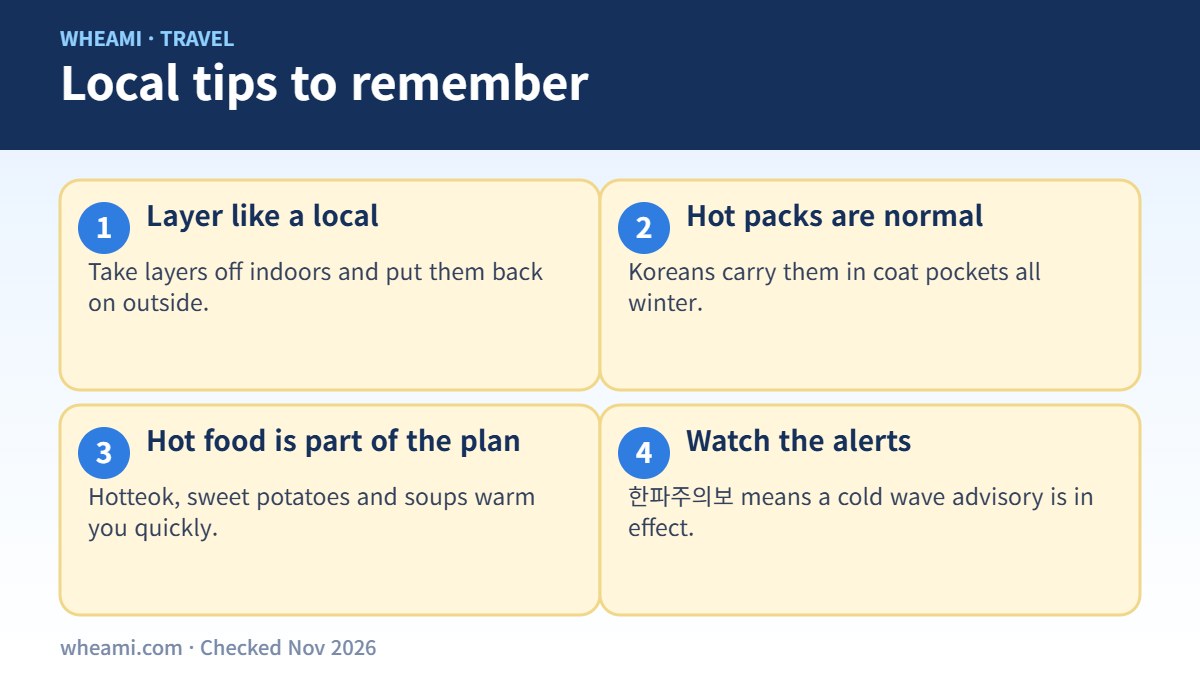
Local tip: Keep a hot pack in each pocket. Koreans use them on commutes and at outdoor events, and they cost very little at any convenience store.
Local tip: Dress in layers and treat indoor heat as normal. Take your coat off in cafes and restaurants so you do not overheat and then feel cold outside.
Local tip: Watch for cold wave alerts. The word 한파주의보 appears in phone notifications and news, and a sudden drop can be more dangerous than steady cold.
Local tip: Eat something hot every few hours. Hotteok, sweet potatoes and soups are the easy local way to reset when your hands go numb.
FAQ
Is Seoul really below freezing in winter? Usually, yes. The January average low is about minus 5 C and the high about 2 C, though individual years vary.
Where can I buy hot packs? At convenience stores such as CU and GS25 and at Daiso. Use them on clothing, not on bare skin.
Do I need a long padded coat? It helps in wind and long outdoor days. You can pack one or buy one in Korea.
Are indoor spaces warm? Often yes, and ondol floors are common. Some older restaurants and hotels may lack conventional heaters, so ask when you book.
What happens with snow on Jeju? Heavy snow can cancel many flights. On February 8, 2026, 163 of 461 flights were cancelled, so allow a buffer day.