

Quick answer: Seoul subway lines are numbered and color-coded, with signs in English. Pay with a rechargeable transit card, or buy a single-journey ticket at a kiosk and get the KRW 500 deposit back at a refund machine. Tap in when you enter and tap out when you leave, and check first and last trains for your own station in the Seoul Subway app.

How the lines and signs work
Station names and line numbers appear in English as well as Korean, and each line has its own color and station numbers. To change lines, follow the colored line and transfer signs inside the paid area. Do not walk out through the fare gates unless your route requires it. The Seoul Metropolitan Government’s Seoul Subway app shows routes, directions inside stations, and nearby attractions, and it is built with international visitors in mind.
How much does it cost?
Seoul lists these base fares for the first 10 km. Longer trips add KRW 100 for every 5 km.
| Passenger | Transit card | Single-journey ticket |
|---|---|---|
| Adult | KRW 1,550 | KRW 1,650 |
| Youth (13 to 18) | KRW 900 | KRW 1,500 |
| Child (6 to 12) | KRW 550 | KRW 550 |
A single-journey ticket costs KRW 100 more than a transit card for adults, so a card is cheaper if you ride more than once. Our T-money vs Climate Card guide shows which card fits your trip.

Single-journey tickets and the KRW 500 deposit
- Buy the ticket at a station kiosk. You can switch the language on the screen.
- Pay the fare plus a refundable deposit of KRW 500.
- At your destination, tap out through the gate with the ticket.
- Insert the used ticket into a Deposit Refund Device to get the KRW 500 back.
The ticket works for the subway only. It is not a stored-value card for buses.
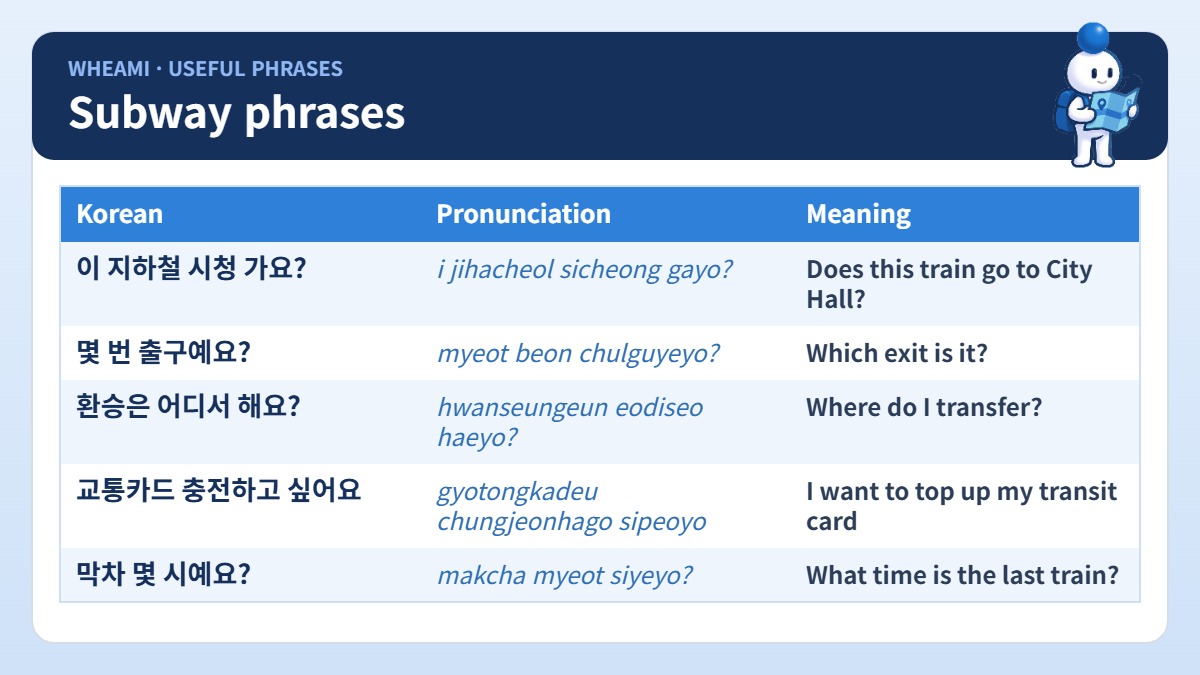
Local tip: Before you leave the train, check which exit you need and whether it has an elevator. In a large station, the right exit can save a long walk, and the Naver Map app shows exit information. Save a screenshot of your line, direction, and destination station as a backup when the station is crowded.
Transfers, and why you must tap out
Seoul’s integrated fare uses the highest base fare among the modes you take and allows up to five transfers, but you must tap when boarding and when getting off. A transfer discount generally applies if your next ride starts within 30 minutes. Seoul lists a 60-minute window between 9 PM and 7 AM. If you forget to tap out, the system cannot calculate the fare correctly.

Can I tap a foreign bank card at the gate?
Not at every gate. Seoul has set up designated ticket and pass machines that accept overseas cards, which is different from tapping a bank card straight on a gate or bus reader. A rechargeable transit card or a single-journey ticket is still the practical choice. Read more in our guide to foreign cards in Korea.
First and last trains
As a rough guide, Seoul Metro describes service as about 5:00 AM to 1:00 AM on weekdays and 5:00 AM to midnight on weekends and holidays. That is not a promise for every line or station. First and last departures change by station, direction, line, and day, so check your departure station, direction, and date in the Seoul Subway app before a late night out.
Luggage lockers and storage
- T-Luggage: staffed storage and same-day delivery at selected stations, including Seoul Station (B1 near Exit 1), Hongik University Station (B1 near Exits 3 to 4), Jamsil, Myeong-dong Station (B1 near Exits 9 to 10), Gimpo International Airport, and Jongno 3(sam)-ga.
- T-Locker: self-service hourly lockers, listed at 336 locations in 273 stations. For four hours, the base rate is KRW 2,200 for a small locker on weekdays (KRW 3,100 on weekends), KRW 3,300 for medium (KRW 4,600), and KRW 4,400 for large (KRW 6,100). Extra hours cost more. The T-Locker app is Korean only.
- T-Storage: monthly storage, not a tourist hourly locker.
Accessibility
Seoul publishes station-level information on elevators, escalators, accessible toilets, and wheelchair lifts or ramps. Facilities differ by station, and an elevator at one entrance does not mean every transfer route is step-free. If you use a wheelchair, a stroller, or carry heavy luggage, check your station and entrance in the official accessibility list first.
Local tip: With a suitcase, the best route is not always the one with the fewest transfers. Compare elevator access and the length of transfer corridors, since some escalators lead to stairs. At Seoul Station, a local commuter advises against following the crowd after you arrive on AREX. Follow the signs for your Line 1 or Line 4 transfer and the elevator route, and confirm the layout on the station map, because stations and elevators can change.
Etiquette
- Priority seats are for older people, people with disabilities, pregnant passengers, and others who need them. Leave them free even if they look empty.
- Let people get off before you board, and do not block the doors.
- Keep luggage out of the aisle, and keep your voice low.
Local tip: If a cafe or restaurant does not show up in your map search, try its Korean name in Hangul. Smaller local places are often listed only in Korean. Copy the name from the venue’s own page or a reliable listing into Naver Map.
What visitors report
These are individual accounts, not measured crowd or walking-time data.
- In March 2026 a discussion of a Seoul subway guide agreed the system is clean and efficient, but several commenters found transfer walks, stairs, and rush-hour crowds tiring, especially in hot weather or with luggage.
- In October 2026 a self-described Seoul Station commuter warned arriving AREX passengers with suitcases that some escalator paths lead to stairs, and advised following signs to specific elevators or transfer routes instead of the crowd.
- In October 2026 a visitor on a ten day stay recommended Naver Map for planning, checking the exit number before leaving the station, and taking a quick screenshot of the line and station order to confirm direction.
Local tip: Before you leave the train, check which exit you need and whether it has an elevator. In a large station the right exit can save a long walk with luggage.
The local view
A Korean practical guide on transfers with suitcases and strollers makes the same point: the route with the fewest transfers is not always the easiest, and elevator access and long transfer corridors can matter more than a few minutes. The Seoul Station commuter also named step-free options, though exact elevators and exit numbers can change, so confirm them on the station’s current map. When a cafe or restaurant does not appear in an English search, copy its Korean name into the map app, since many small local listings are easier to find in Hangul.
Local tip: Allow extra time for transfers at rush hour or with luggage, and keep one screenshot of your line, direction, and the station sequence as a backup for a crowded platform or weak signal.

FAQ
Do I need to speak Korean to use the subway?
No. Signs, announcements, and kiosks include English.
Where do I get my KRW 500 deposit back?
At a Deposit Refund Device in the station where you finish your trip.
Does the subway run all night?
No. Plan to finish before the last train, and check your own station’s time.