

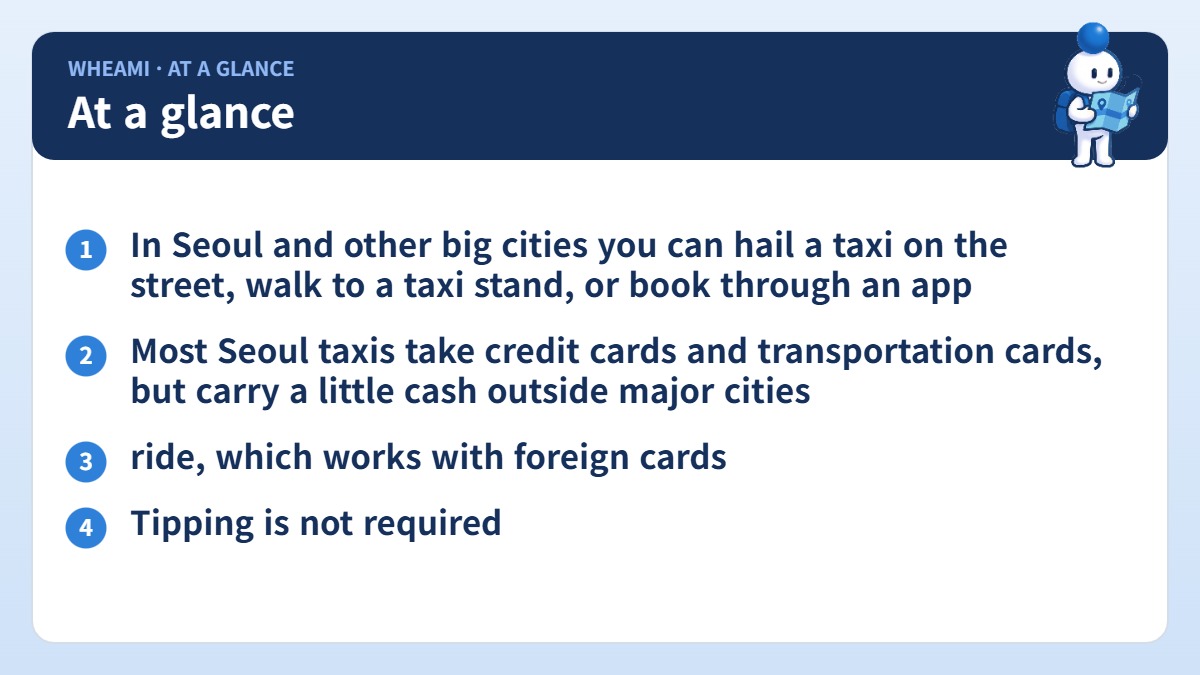
Quick answer: In Seoul and other big cities you can hail a taxi on the street, walk to a taxi stand, or book through an app. Most Seoul taxis take credit cards and transportation cards, but carry a little cash outside major cities. If you do not have a Korean phone number or card, use k.ride, which works with foreign cards. Tipping is not required.
Three ways to get a taxi
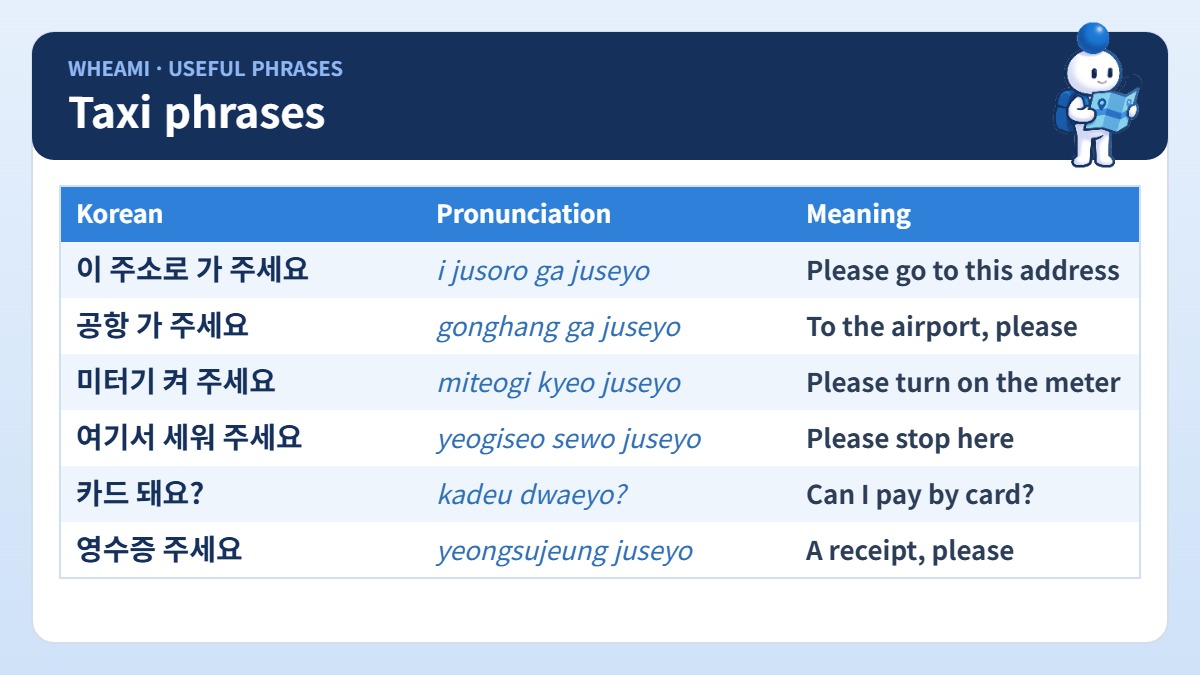
Hail one on the street. Regular taxis have a “TAXI” sign on the roof and yellow license plates. Wave when you see one available, and stand where stopping is allowed.
Go to a taxi stand. Stands are common at bus terminals, major subway stations, and large shopping malls. In Seoul you can call 02-120 to ask where the nearest stand is.
Book through an app. Apps show an estimated fare before you confirm. Call services can add a small fee on top of the fare.
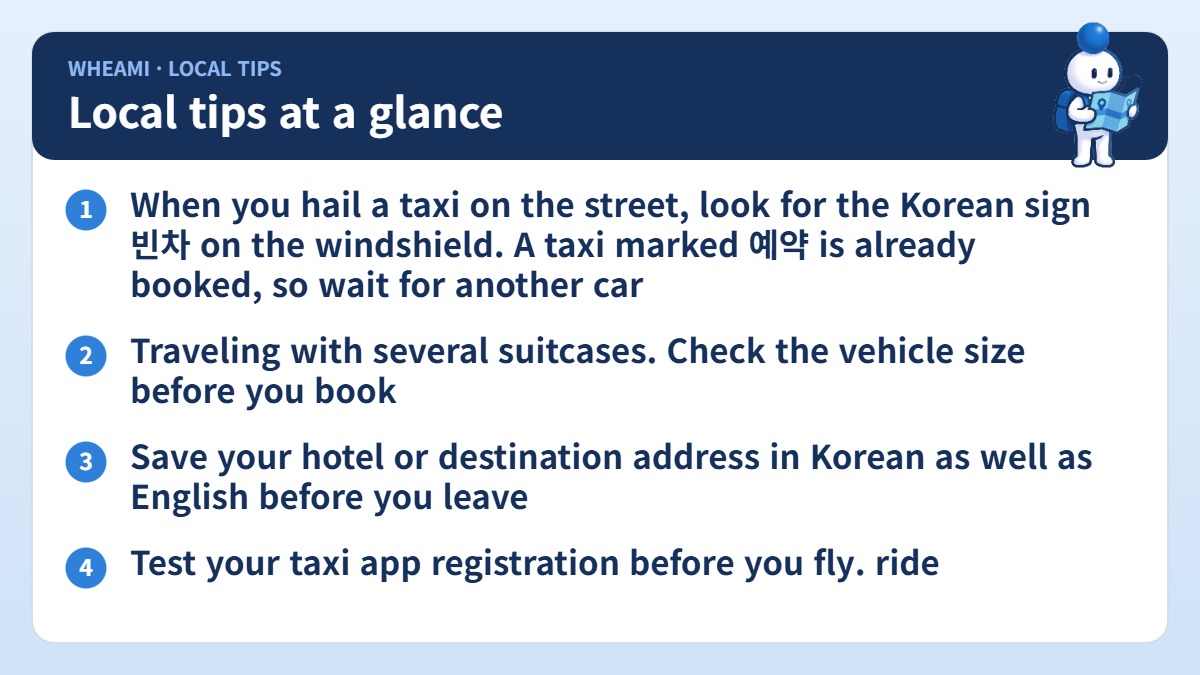
Local tip: When you hail a taxi on the street, look for the Korean sign 빈차 (available) on the windshield. A taxi marked 예약 is already booked, so wait for another car. Seoul’s guide suggests reading the word rather than relying on color alone.
Which taxi type?
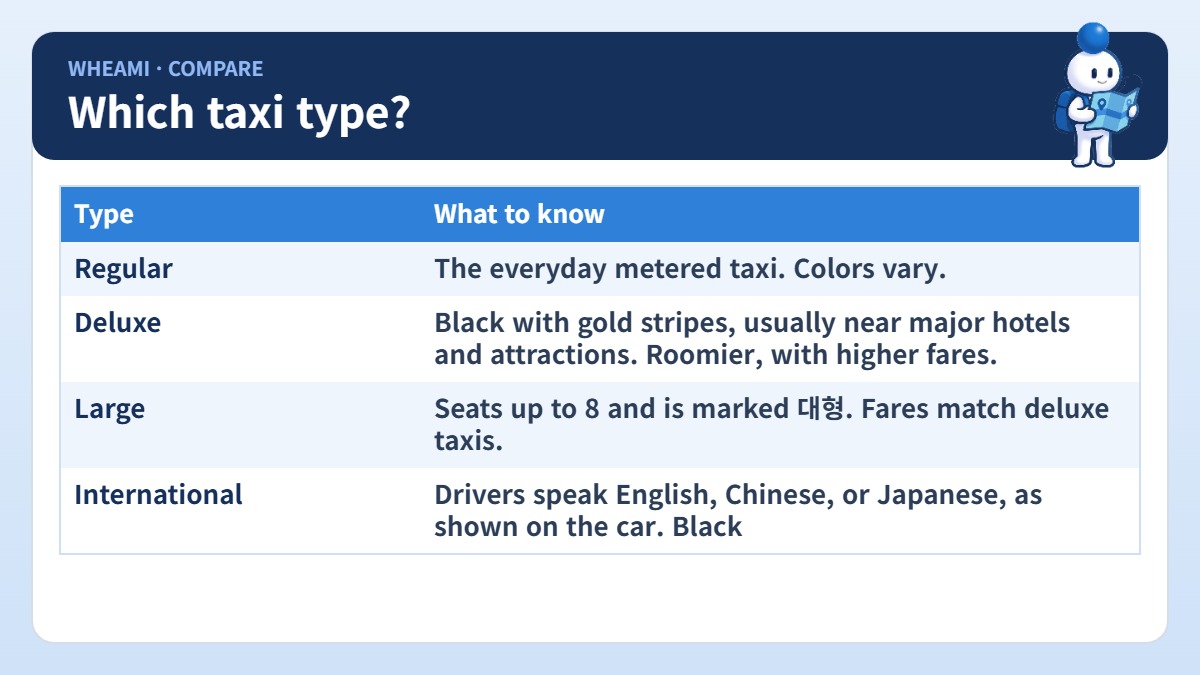
| Type | What to know |
|---|---|
| Regular | The everyday metered taxi. Colors vary (orange, white, and gray are common in Seoul). |
| Deluxe | Black with gold stripes, usually near major hotels and attractions. Roomier, with higher fares. |
| Large | Seats up to 8 and is marked 대형. Fares match deluxe taxis. |
| International | Drivers speak English, Chinese, or Japanese, as shown on the car. Black or orange with 인터내셔널 on the doors. Fares are generally higher, and you can reserve for airport pickup. |
Skip the vans. A vehicle marked 밴 or 콜밴 is not a taxi. It has no meter and usually costs more. Confirm the price before you get in, or choose a metered taxi.
Local tip: Traveling with several suitcases? Check the vehicle size before you book. A regular taxi may not fit both your group and all your bags, and one group reported drivers canceling after seeing three suitcases. A hotel can often help book a suitable vehicle in advance.
How much does a taxi cost?
Fares are metered by distance and time, and they differ by city and taxi type. The Korea Tourism Organization lists these base fares for a regular taxi. The distance they cover differs by city, and Seoul’s own fare table covers the first 1.6 km.
| Region | Base fare |
|---|---|
| Seoul, Busan, Incheon, Gyeonggi-do, Gwangju | KRW 4,800 |
| Gangwon | KRW 4,600 |
| Daegu, Ulsan | KRW 4,500 |
| Daejeon, Jeju | KRW 4,300 |
After the base distance, the meter adds about KRW 100 for every 130 to 150 meters, and it also runs on time when traffic is slow. In Seoul, a deluxe taxi starts at KRW 6,500 for the first 3 km.
Seoul fare table. A regular taxi in Seoul starts at KRW 4,800 for the first 1.6 km during the day, then adds KRW 100 for every 131 meters, or for every 30 seconds in slow traffic. Between 22:00 and 23:00 and between 02:00 and 04:00, a 20% surcharge applies, and from 23:00 to 02:00 it is 40%. Trips that leave the city add 20%, and the total can reach 60%.
The Seoul table is the one published on the city’s English page, which lists it as effective from February 1, 2023, so fares may have changed since. Treat the meter and the app estimate as the real price.
Local tip: Save your hotel or destination address in Korean as well as English before you leave. If the address is hard to identify, show the driver a nearby subway station or a well-known landmark. In an app, move the pickup pin to the actual curb instead of the middle of a large building.

Taxi apps for visitors
k.ride from Kakao Mobility is built for visitors. The app works in English, Japanese, and Chinese. You can sign up with Google, Apple, or email, though sign-up asks for your name, phone number, and country. It supports foreign-issued cards and mobile wallets such as Alipay and GrabPay, and shows an estimated fare before you call a car. A card can still be declined, so keep some cash as a backup. Uber Taxi is also available if you already use Uber.
If you use a Korean app such as Kakao T, check whether it accepts your card before you rely on it. Payment options depend on your account, and a Korean phone number or card may be required.
Local tip: Test your taxi app registration before you fly. Some visitors found that one app’s phone verification did not work with their number and switched to k.ride. Reports vary by app version and account, so keep a backup option instead of retrying one app at the arrivals curb.
How to pay
- In the app: Pay through the app when it offers prepaid payment. If you already paid in the app, do not pay the driver again.
- In the taxi: Most Seoul taxis accept credit cards and transportation cards. Cash works everywhere.
- Outside big cities: Some taxis in remote areas may ask for cash, so keep a small amount on hand.
Tipping is not required.
Before you get in
- For an app ride, match the license plate with the car shown in the app.
- Use a marked taxi, not an unmarked car or a van.
- Check that the meter starts when you leave, unless you booked a published fixed-fare service.
- Keep the receipt or the trip record in the app.
Local tip: Korean taxi doors are not automatic, so you open and close the door yourself.
If something goes wrong
In Seoul, the 120 Dasan Call Center (02-120) takes taxi complaints and supports English and several other languages. The 1330 Korea Travel Helpline (02-1330) can also help visitors. Keep your receipt and the plate number, because both help when you report a problem.
What visitors report
These are individual trips, not measured cancellation rates or universal app behavior.
- In a 2026 group trip report, the writer could not finish Kakao T registration because the app flow asked for a Korean carrier number, so they used k.ride instead. A commenter said they had logged in with KakaoTalk and a US number, which shows that eligibility varies by app version and account.
- The same trip report described drivers canceling, or asking the group to cancel, when three suitcases would not fit. The writer suggested asking the hotel to help book a suitable vehicle when you travel with several bags or on a tight schedule.
- In a 2024 discussion, some visitors used k.ride successfully for a week and others used Uber or Kakao T. One commenter had trouble getting a ride at busy times, which is why a backup method helps.
Local tip: If one app will not complete registration, switch to a visitor-friendly service such as k.ride or ask your hotel to call a taxi. Do not spend your arrival time retrying the same app.
The local view
Seoul’s official taxi guide gives a few habits that locals treat as normal. A taxi showing 빈차 (bincha) is available, and 예약 (yeyak) means it is already booked, so read the word and do not rely on color alone. Many drivers do not speak several languages, so show the address in Korean or name a nearby landmark or subway station. For an app taxi, compare the license plate with the one in the app before you get in, and if you paid in the app, do not pay the same fare again. Korean taxi doors are not automatic, so you open and close the door yourself.
Local tip: Move the pickup pin to the actual curb or designated pickup area, not the middle of a large building or mall, and add the building name or nearest subway exit when you save an address.
FAQ
Do Korean taxis take foreign credit cards?
Many Seoul taxis take credit cards, but acceptance is not guaranteed for every card. Paying in a visitor app such as k.ride avoids the problem, and a little cash is a good backup.
Do I need to tip?
No. Tipping is not required.
Is a taxi cheaper than the subway?
Usually not. A taxi is easier with luggage or when you travel as a group, and the fare is shared.
Can I get a taxi to the airport?
Yes. International taxis offer airport pickup and drop-off, and you can reserve in advance or at the desk at Incheon Airport. Check the fare before you ride, because airport trips use a separate fare table.