

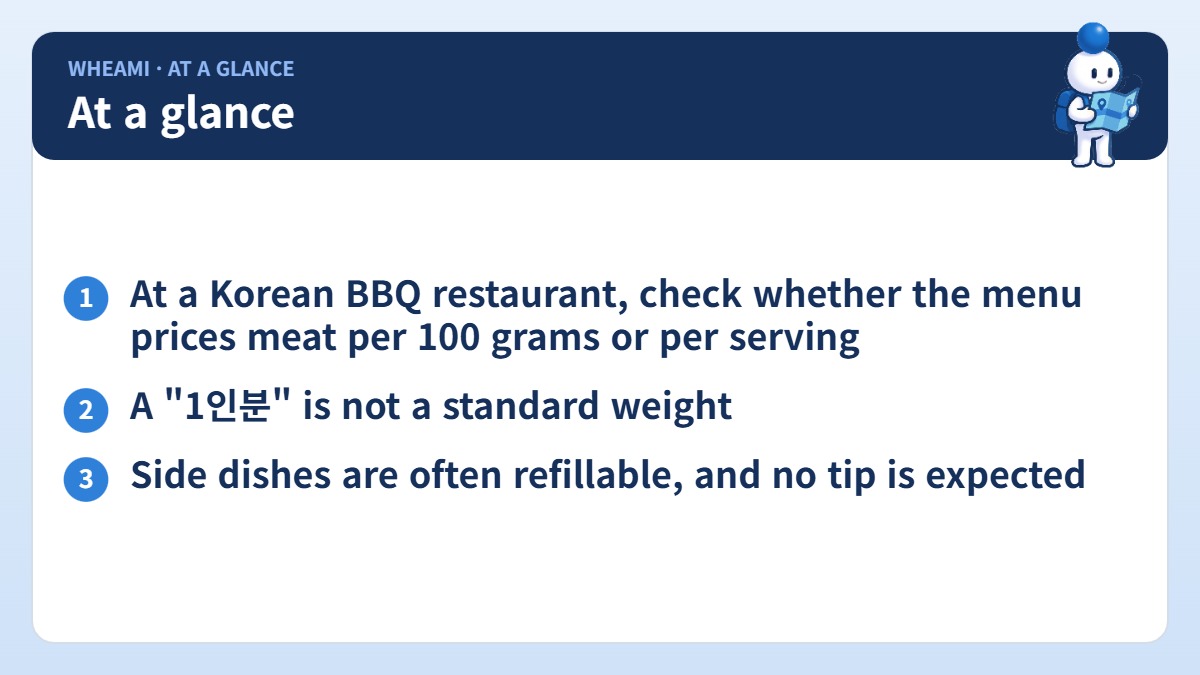
Quick answer: At a Korean BBQ restaurant, check whether the menu prices meat per 100 grams or per serving, find out whether staff grill the meat, and ask before sitting down if you are alone. A “1인분” (one serving) is not a standard weight. Side dishes are often refillable, and no tip is expected.
How Korean BBQ works
Korean BBQ restaurants, called gogi-jip, grill meat at the table. You eat it with banchan (side dishes), stews, noodles, and lettuce or perilla leaves for wrapping, called ssam. Popular orders include samgyeopsal (grilled pork belly), moksal (pork neck or shoulder), and galbi (ribs, sometimes marinated). Some restaurants have staff grill the meat for you, and others expect you to cook it yourself. Neither is universal, so look at what nearby tables are doing or ask.
What does “1인분” mean?
“1인분” means one serving, but the weight and price differ by restaurant and by meat. Korean consumer guidance says meat prices should be shown per 100 grams. When a one-serving price is also shown, the serving weight should be shown with it, with examples like “galbi 100g, 1 serving 150g.” The posting requirement applies to larger restaurants (150 square meters and up), so smaller shops may display things differently.
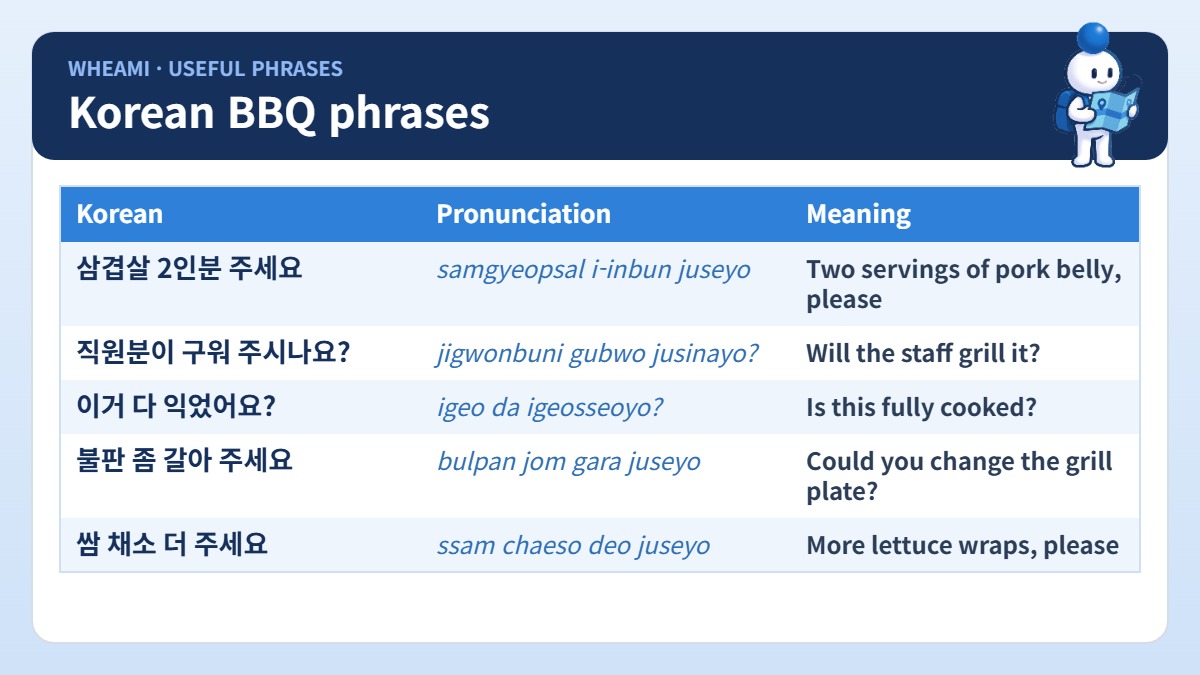
Local tip: Compare the grams and the total price before you order. That is how many Korean diners judge value, because one restaurant’s “one serving” may be a different weight from the next.
Can you eat Korean BBQ alone?
There is no national rule. Many restaurants have a minimum of two servings, and some have solo seats or single portions. Travelers report mixed results: one was turned away at two Busan restaurants but later found one that accepted a 300 gram beef order, while another traveler on a long stay said they were accepted at the BBQ places they tried. A restaurant may still decline one guest during busy hours even if you offer to order two servings.
Local tip: Ask before you sit down: “혼자인데 2인분 시켜도 될까요?” (I’m alone. May I order two servings?) Then you know the answer before you take a table.
Who grills the meat?
Ask “직원분이 구워주시나요?” (Does the staff grill the meat?). If you cook it yourself, use the tongs to turn the meat and the scissors to cut it after the surface is browned. If you are unsure, ask the staff to show you before you touch the grill. If the plate gets dark, say “불판 좀 갈아 주세요” (Could you change the grill plate?).
Ssam, banchan, and refills
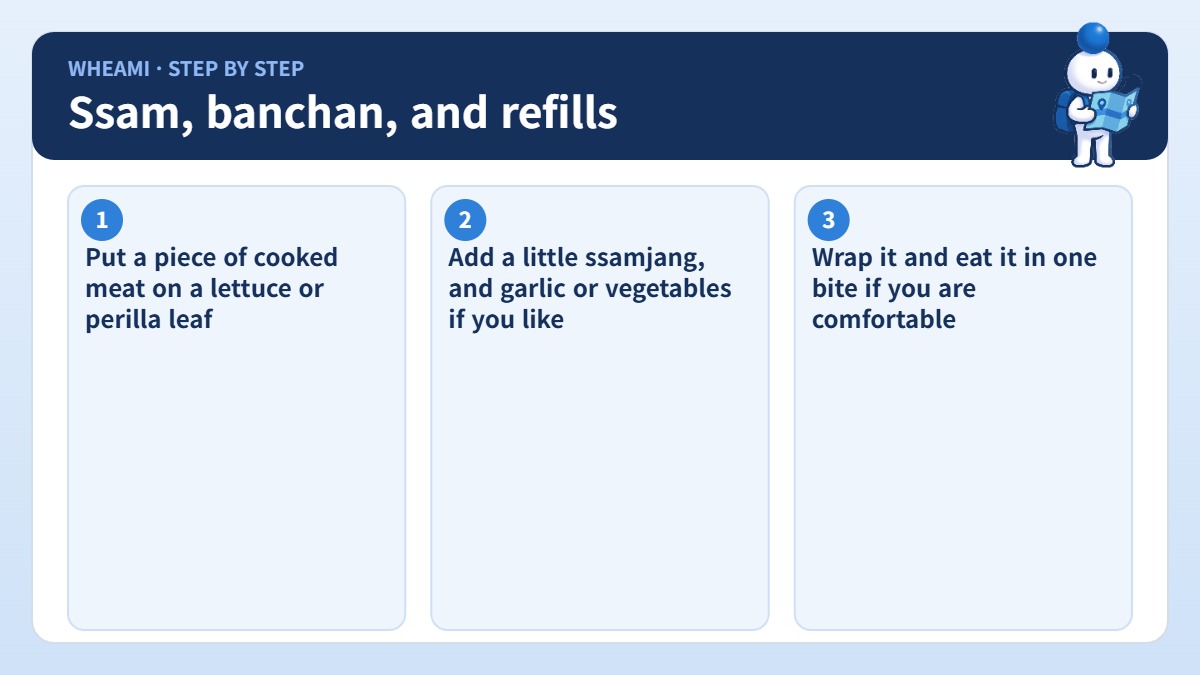
- Put a piece of cooked meat on a lettuce or perilla leaf.
- Add a little ssamjang, and garlic or vegetables if you like.
- Wrap it and eat it in one bite if you are comfortable. A smaller wrap is fine.
VISITKOREA says extra water and side dishes are generally not charged in regular restaurants, but self-service setups are increasingly common.
Local tip: Look around for a “셀프바” (self-service bar) sign before you wait for a server to bring more side dishes. Many places let you refill selected banchan and water yourself, but the setup differs by restaurant.
Rice, stew, and drinks
Rice, stew, noodles, and drinks are often separate menu items, so check the menu before you assume they are included. Many diners finish with rice and doenjang-jjigae (soybean paste stew).
Calling staff, paying, and tipping
- Press the table call button if there is one. If not, say “여기요” or “저기요” to get attention.
- Check the table drawer for spoons, chopsticks, and napkins before you ask.
- No tip is expected at ordinary Korean restaurants.
- When you are ready to pay, say “계산할게요” (I’d like to pay). For cards and cash tips, see our foreign card guide.
Useful phrases
| Korean | Meaning |
|---|---|
| 삼겹살 2인분 주세요 | Two servings of pork belly, please |
| 혼자인데 2인분 시켜도 될까요? | I’m alone. May I order two servings? |
| 직원분이 구워주시나요? | Does the staff grill the meat? |
| 이거 다 익었어요? | Is this fully cooked? |
| 불판 좀 갈아 주세요 | Could you change the grill plate? |
| 반찬 더 주세요 | Could I have more side dishes? |
| 계산할게요 | I’d like to pay |
What visitors report
These are individual accounts. They show variation, not a rule.
- In June 2026 a solo traveler asked how to get into barbecue restaurants. Replies described ordering two portions, finding solo-focused shops, and being refused at one Busan restaurant but welcomed at another on Jeju.
- In June 2025 a solo traveler was refused at two Busan barbecue restaurants and later found one that accepted a 300 g beef order. Replies said two-portion minimums are common but experiences vary.
- In November 2025 another solo traveler spent two and a half weeks in Korea without being turned away. They were accepted at the barbecue places they visited, many of them self-grill venues, which is a useful contrast to the refusal stories.
- In an older 2022 discussion visitors asked who is supposed to grill the meat. The answer was that some restaurants grill for you and others leave it to diners, which matches the official explanation.
Local tip: If you eat alone, ask before you sit down: “혼자인데 2인분 시켜도 될까요?” (I am alone, may I order two servings?) Even then a restaurant may decline during busy hours, depending on its table layout and policy.
The local view: how locals eat barbecue
Staff-grilled service is part of the experience at some restaurants, especially higher-priced ones, while at others the diners cook. A 2026 community discussion about a meal in Yeonnam describes staff managing the pork belly and pork neck from start to finish, and treats it as a local example, not a citywide rule. Another local-style account describes grilling onion, mushrooms, and kimchi next to the pork belly, then finishing with rice and doenjang-jjigae. It notes that flat tabletop pans may suit fried rice, while traditional charcoal or iron grates may not, and that is one family’s meal, not a technical rule.
A smart local habit is to compare weight and price, not the word “serving.” Korean legal guidance says food prices must be shown as final prices including VAT, and for meats such as bulgogi and galbi the menu should show the price per 100 g, with the serving weight and price shown together if a one-serving price is displayed. The posting rule for the menu board applies to restaurants of 150 square meters or larger, so do not assume it applies identically to every small shop. The official examples are examples, not a universal portion size.
Local tip: Check whether rice, stew, noodles, and drinks are separate menu items before you assume they are included. No tip is expected at an ordinary barbecue restaurant, as our tipping guide explains.
Useful phrases
| Korean | Meaning |
|---|---|
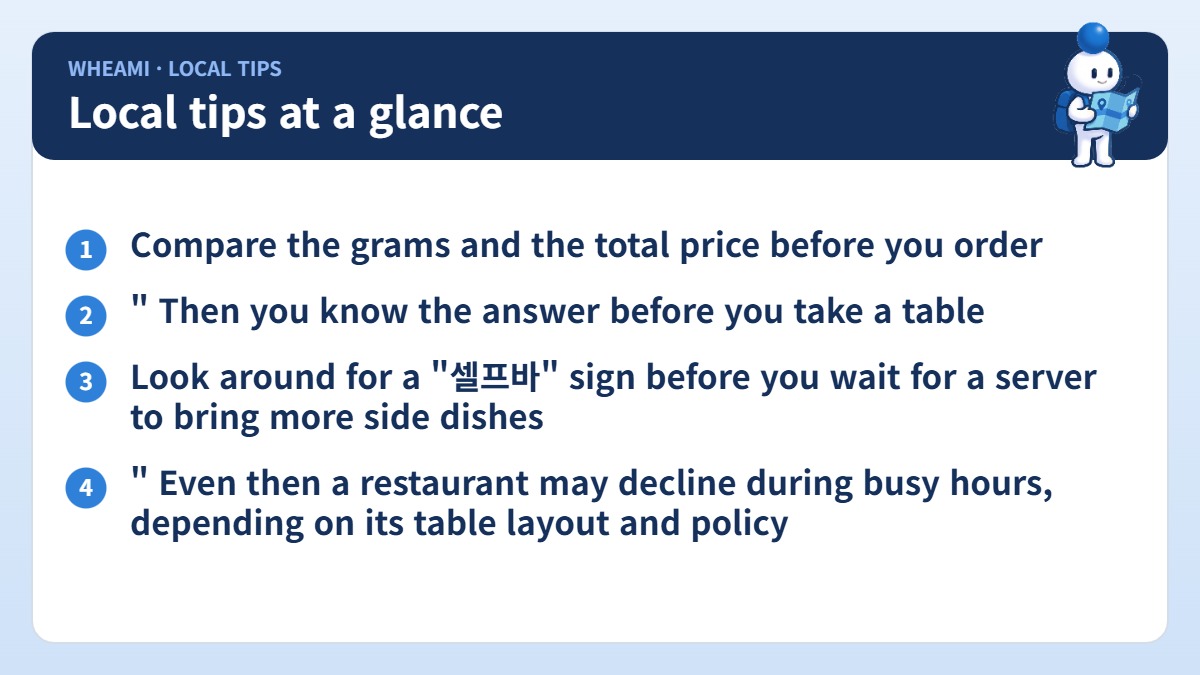
| 삼겹살 2인분 주세요 | Two servings of pork belly, please |
| 직원분이 구워주시나요? | Does the staff grill the meat? |
| 이거 다 익었어요? | Is this fully cooked? |
| 불판 좀 갈아 주세요 | Could you change the grill plate? |
| 반찬 더 주세요 | Could I have more side dishes? |
| 계산할게요 | I would like to pay |
For the rest of the dining flow, see our restaurant etiquette guide.
FAQ
Is the food served pre-cooked?
No. Meat is grilled at the table, either by you or by staff.
Does one serving feed one person?
Not always. Check the grams on the menu.
Where can I find a restaurant?
Search the Korean name in a map app. See our essential apps guide.