
Quick answer: In Korea, “halal certified”, “Muslim friendly” and “pork free” are not the same. Certified halal places are the clearest choice, and Itaewon around Seoul Central Mosque has the biggest cluster. Elsewhere, ask about pork, broth and alcohol in cooking, because they are often left out when staff say a dish has no meat.
What the labels mean
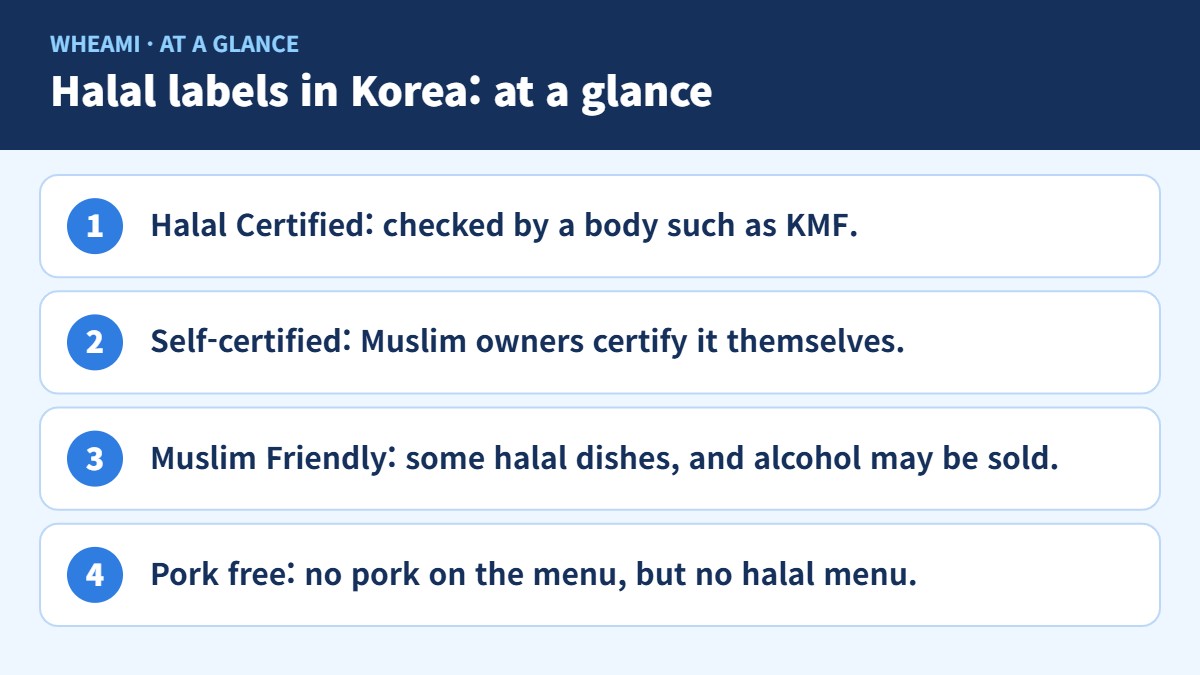
The Korea Tourism Organization (KTO) groups restaurants for Muslim visitors into four categories. Knowing them saves a lot of disappointment at the door.
| KTO category | What it means | What to still ask |
|---|---|---|
| Halal Certified | Certified by an accredited halal body, such as the Korea Muslim Federation (KMF) | Look for the certifier name on site; ask if the certificate is current |
| Self-certified | All food is halal, and Muslim owners certify it themselves | This is not a third-party certificate, so decide whether it meets your own standard |
| Muslim Friendly | Some halal dishes, and alcohol may be sold | Ask which dishes are halal and how they are prepared |
| Pork free | No halal menu, but no pork on the menu | Ask about alcohol, broth and shared utensils |
KTO also warns that hotel restaurants and buffets labeled Muslim friendly may still serve pork. I could not confirm what the certification marks look like, so ask staff to show the certificate rather than relying on a logo. Individual standards differ, and this article is not a religious ruling. Follow your own scholar or standard.
Hidden ingredients
The most common surprise is not an obvious pork dish. It is an ingredient that nobody thought to mention. A Korea Herald report from 2017 noted that small amounts of alcohol are sometimes added to seafood soups and braised seafood for aroma, and that a restaurant described as halal had pork on its menu. Student interviews in the Korea JoongAng Daily in 2022 described the same worry: meat can be cooked with lard or mixed with pork.
- Broth: kimchi stew, soybean paste stew and ramyeon may use anchovy, beef or pork bone stock.
- Sauces and seasoning: mirin and rice wine appear in many marinades.
- Fermented seafood: salted shrimp and other jeotgal are in most kimchi.
- Shared grills: a barbecue grill may be used for pork and other meat in the same session.
- Convenience food: ham in kimbap and meat in tteokbokki are easy to miss.
Local tip: Koreans often answer “no meat” meaning the visible ingredients. Ask a second question about the broth, then a third about alcohol. Three short questions get you an honest answer without making anyone uncomfortable.

Where to find halal food
The biggest cluster is around Seoul Central Mosque in Itaewon, where restaurants, grocery shops and halal butchers sit within a short walk. Searching for the Korean word 할랄 (hallal) in Naver Map or Kakao Map brings up places, and a quick message or call before you go avoids a wasted trip. Outside Seoul, choices thin out quickly, so plan meals and keep snacks you trust. If you are also managing allergies or dietary needs, our guide to food allergies and dietary restrictions covers separate steps. For BBQ in particular, see the Korean BBQ guide.
| Place | Good for | Watch for |
|---|---|---|
| Itaewon halal restaurants | Certified or Muslim-owned meals | Opening hours and reservations vary |
| Halal grocery shops | Packaged food, spices, ready meals | Check ingredient lists for gelatin and alcohol |
| Regular Korean restaurants | Vegetable and seafood dishes | Broth, sauces and shared grills |
| Convenience stores | Snacks and drinks | Read labels; ham and gelatin appear often |
Prayer spaces
Seoul Central Mosque in Itaewon is the best-known place to pray. KTO says it supports prayer rooms at some hotels and tourist sites. Incheon Airport has had multi-faith prayer rooms, though the sources I found about their locations are old, so confirm with the airport on arrival. A 2018 news report counted 78 prayer rooms nationwide, mostly in mosques, universities and hospitals.

Useful phrases
These phrases are polite and short. Show them on your phone if needed.
| Korean | Pronunciation | Meaning |
|---|---|---|
| 저는 무슬림이에요 | jeoneun museullimieyo | I am Muslim |
| 돼지고기 안 먹어요 | dwaejigogi an meogeoyo | I do not eat pork |
| 돼지고기 있어요? | dwaejigogi isseoyo | Is there pork? |
| 육수 뭐로 내요? | yuksu mworo naeyo | What is the broth made from? |
| 술 들어가요? | sul deureogayo | Does it contain alcohol? |
| 할랄 음식 있나요? | hallal eumsik innayo | Do you have halal food? |
Search word for your map app: 할랄 (hallal)

What visitors report
Written accounts from Muslim visitors to Korea are fewer than I hoped, and most I found are interviews or older blogs. I did not find a first-hand story of a pork-broth surprise, so I will not invent one. What I did find is consistent.
- In September 2017, the Korea Herald described a chef who was told a restaurant was halal, only to find pork on its menu. A TV personality said the first Korean phrase many Muslims learn is “no meat, please”.
- In March 2022, students from Indonesia, Bangladesh and Senegal told the Korea JoongAng Daily how they cope. One asks “dwaeji gogi isseoyo?” and worries about lard. One reads ingredient lists. One buys halal food at an Itaewon mart.
- An Egyptian Muslim woman living in Korea wrote on a blog (undated, probably from the 2010s) that meat tteokbokki may contain pork and tuna kimbap from convenience stores may contain ham.
The local view
For many Koreans, halal is a new idea. Pork is part of everyday cooking, and broths and sauces are decided in the kitchen, not on the menu. A Korean restaurant owner who answers “there is no pork” is usually speaking about the main ingredients, not the stock or the seasoning. That is not carelessness. It is that the question has simply never been asked.
So the helpful approach is the specific question. “Is there pork?” is less useful than “What is the broth made from?” and “Does it have alcohol?”.
Local tip: Message the restaurant on Naver Map, Kakao Talk or by phone a day ahead and ask whether they can cook without pork and alcohol. Many small places will say yes if they know in advance, and no if they are unsure, which is also a useful answer.
Local tip: Buy packaged food with the ingredient list in hand. Look for gelatin (젤라틴), lard (라드) and alcohol (알코올) in the Korean text, and keep a few trusted snacks for days when you cannot confirm a meal.

FAQ
Is all food in Itaewon halal? No. Itaewon has the largest cluster, but you should still check each restaurant for certification and ask about pork and alcohol.
Does Muslim friendly mean halal? Not necessarily. KTO uses it for places with some halal dishes, and alcohol may be sold.
Can I trust a “no meat” answer? Not on its own. Ask about broth, sauces and shared cooking surfaces.
Are there halal options outside Seoul? Fewer. Plan ahead, ask the restaurant before you go, and carry backup food.