

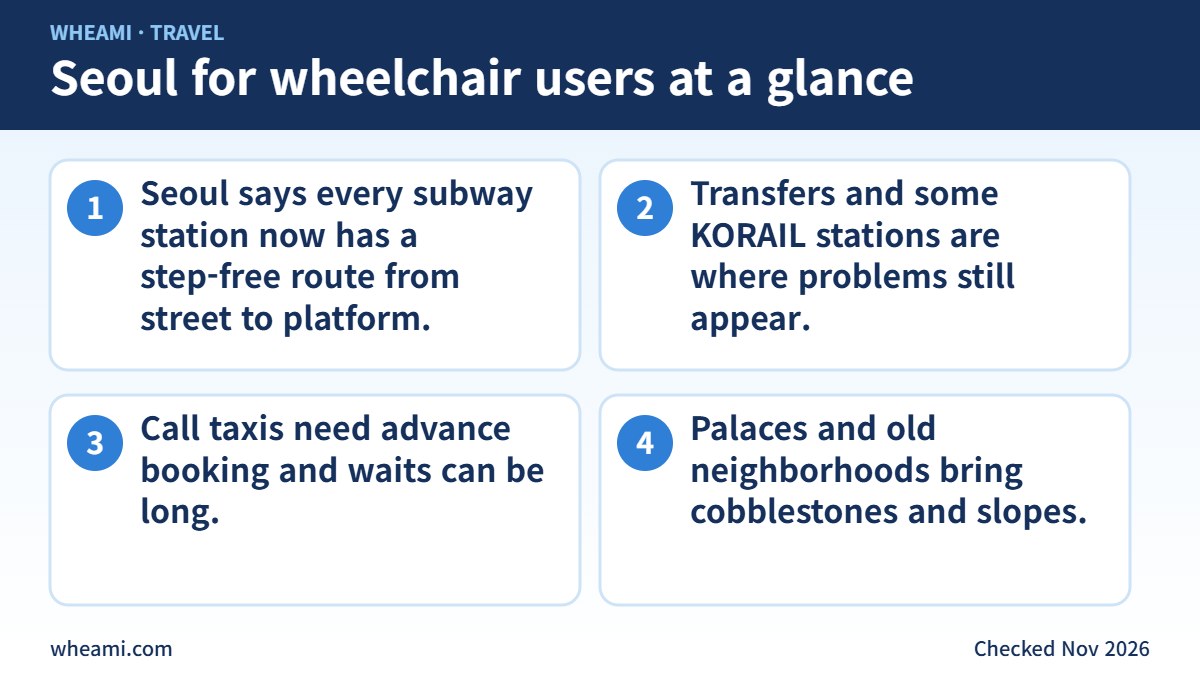
Quick answer: Seoul is workable for wheelchair users, mostly because of the subway. The city says every station now has an elevator route from street to platform. The weak points are transfers, a few stations run by KORAIL, call taxis that need advance booking, and sights with cobblestones or hills. Plan fewer stops per day and check each route the day before.
How accessible is Seoul?
Better than many visitors expect, and uneven in ways that official pages do not always show. The biggest change is the subway. In late December 2025 Seoul announced that all 338 of its stations have a step-free route from the street to the platform, a project it calls One Station, One Route. Disability advocates answered that some stations run by KORAIL still lack elevators and that changing between operators remains hard, so treat the claim as true for most trips and not as a promise for every route.
The second thing to know is that Seoul is built on hills and has many older neighborhoods. Palaces use cobblestones, hanok areas climb slopes, and small restaurants often have a step at the door. A wheelchair user who plans around the subway, a few big sights and flat areas such as the Han River parks will have an easier time than one who tries to copy a standard first-timer itinerary.
This guide covers the pieces that decide a day: the subway and its transfers, taxis and buses, rentals and help, and the sights where the ground gets difficult. It is a planning guide, not medical or legal advice, and the facts that change, such as fares, waiting times and opening days, are left to the official pages linked at the end.
Subway elevators and transfers
Think of the subway as your main road. Most stations have two elevator rides, one from the street to the ticket hall and one from the hall to the platform. The street elevators are often glass boxes with little signage, which is why first-time visitors walk past them. Seoul Danurim, the city tourism accessibility site, notes that a few older stations still use a wheelchair lift, and that you should ask the station attendant for help there. The platform gap is small on most lines, but one transfer station that a Korean advocate described has a gap she called dangerous, so ask for the ramp at any station where you are unsure.
Seoul city says the Ttota Subway app shows which exit has an elevator and how wide the platform gap is. Kakao Map is the other app that Seoul Danurim recommends for accessibility information. The Seoul Metro English app exists, but I could not confirm how much elevator detail it gives, so test it before your trip. For general ticketing and fares, see our Seoul subway guide.
| Situation | What to expect | What to do |
|---|---|---|
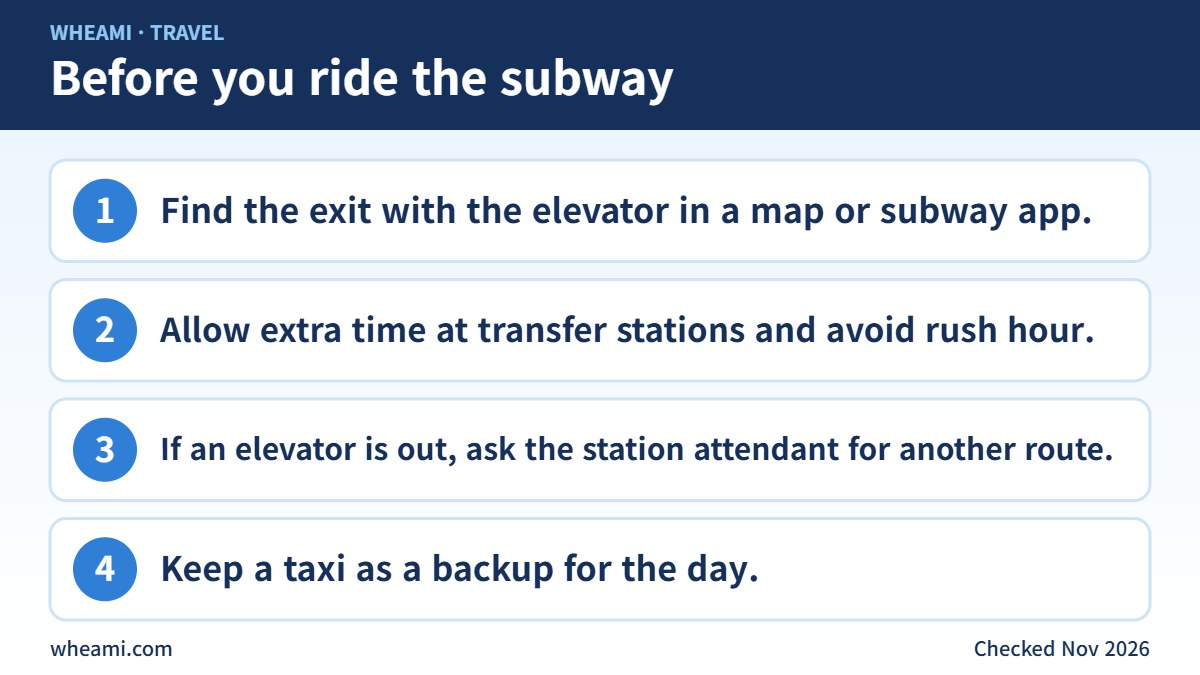
| Ordinary station | Street elevator to the hall, then another to the platform | Choose the exit with the elevator before you leave |
| Transfer station | Long underground walks, sometimes a second elevator trip | Allow extra time and avoid rush hour |
| Older station | May use a lift instead of an elevator | Call the attendant at the gate or use the call button |
| Elevator out of service | Detour to another exit or station | Ask staff for the nearest working route and keep a taxi as a backup |
Seoul says it sends text alerts about elevator outages to subscribers. I could not confirm that visitors can sign up, so do not count on it. The practical backup is the same one Koreans use: ask a station attendant.
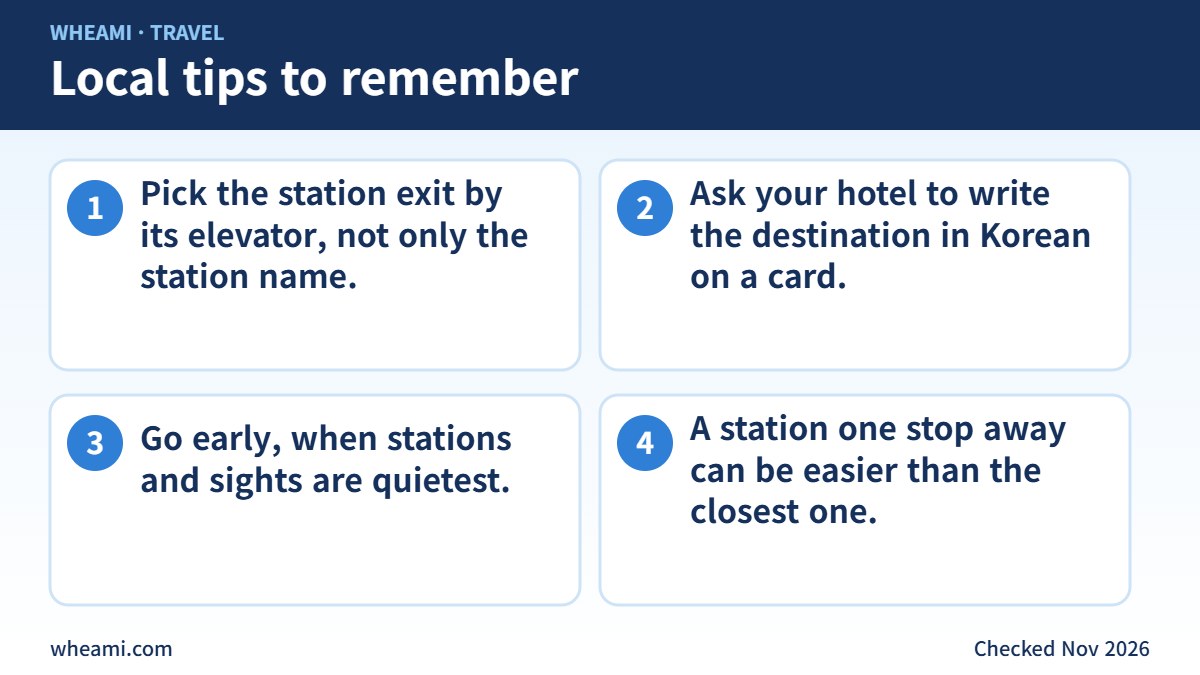
Local tip: Search the exit number, not only the station name. Two exits of one station can be a ramp apart or a flight of stairs apart. Korean parents with strollers check the elevator exit in the map app before they leave, and the same habit works for a wheelchair.
Taxis, buses and rentals
Regular taxis work for short rides if your chair folds, since the driver puts it in the trunk. If you use a power chair, the options narrow. Seoul Danurim lists jumbo taxis and an international taxi service for larger vehicles, and it says that foreigners who use a wheelchair can reserve the city call taxi for people with disabilities. Booking is in advance, and waits of 30 to 90 minutes are mentioned on its pages. Fares, eligibility and the phone number should be checked on the official page before you rely on any of this.
Buses are the weakest link. Seoul has been replacing its fleet with low-floor buses and the share was reported at about 73 percent in April 2024, with a target of 100 percent. Even so, Seoul Danurim advises visitors to use the subway and taxis where possible, because bus stops have little English signage. The Seoul Donghaeng Map app, launched in November 2024, offers step-free routing and lets users reserve a low-floor bus, but it was built for residents and I could not confirm that visitors can use every feature.
| Option | Good for | Check first |
|---|---|---|
| Subway | Most trips across the city | Elevator exit and transfer route |
| Regular taxi | Short rides with a folding chair | Whether the driver can load the chair |
| Call taxi for people with disabilities | Chair users who cannot transfer | Foreigner eligibility, fare and waiting time |
| Low-floor bus | Short hops when you know the stop | Route, stop and the app you will use |
| Pre-booked tour van | Full days with a power chair | Operator, vehicle and price |
For loans, Seoul Danurim says its Accessible Tourism Center can lend wheelchairs and portable ramps for a limited period with a refundable deposit, and that Incheon Airport has free wheelchairs at its information desks. Both are worth confirming by phone or email, and the national Korea Travel Helpline, 1330, can help with interpretation for non-emergency questions.
Local tip: A portable ramp solves more problems than people expect. Many Seoul cafes and small restaurants have one step at the door, and the ramp turns a refusal into a yes. Ask the staff before you try, and do not block the sidewalk while you set it up.
Sights, hills and cobblestones
The palaces are the classic problem. The ground at Gyeongbokgung is rough stone, and a power wheelchair user who visited in early 2025 described it as hard going. Seoul Danurim says Changgyeonggung has a wheelchair lift, although that comes from a 2020 guidebook, so confirm it before you plan around it. Bukchon Hanok Village is a series of slopes, and a visitor in 2025 found it steep. Modern places such as museums, department stores and observation towers are usually easier because they were built with elevators.
Hotels need the same attention. Roll-in showers and grab bars are not guaranteed, even in large international hotels, and a 2025 visitor reported a luxury hotel room with no grab bars in the bathroom. Ask for photos of the bathroom and the exact door width, and ask the hotel whether the accessible room is actually free on your dates.
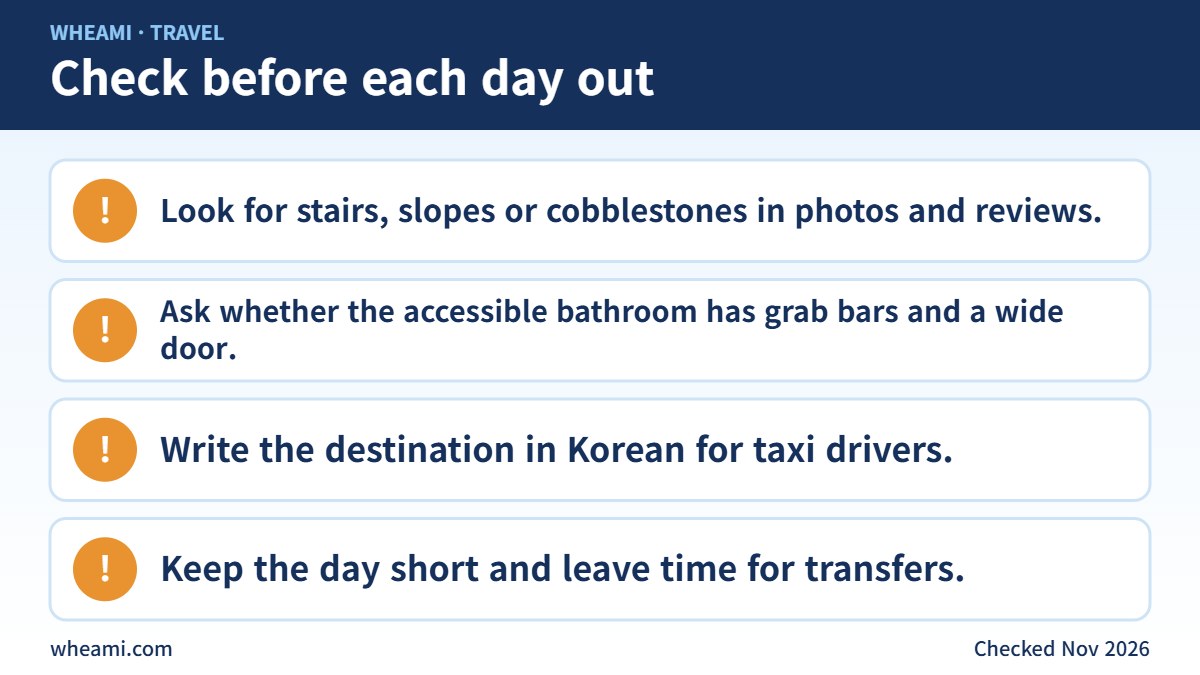
Here is a checklist to run through before each day out:
- Find the nearest elevator exit for both ends of every subway ride.
- Search the destination for stairs, slopes or cobblestones in reviews and photos.
- Check opening days and ask whether wheelchair access is staffed.
- Write the destination name in Korean for taxi drivers.
- Save a backup route by taxi if an elevator is out.
- Keep the day short and leave time for transfers.
Useful phrases
Show the Korean on your phone. Station staff and drivers will respond faster to written Korean than to spoken English.
| Korean | Pronunciation | Meaning |
|---|---|---|
| 엘리베이터 어디예요? | elli-bei-teo eo-di-ye-yo | Where is the elevator? |
| 휠체어 | hwil-che-eo | Wheelchair |
| 고장 났어요 | go-jang na-sseo-yo | It is broken |
| 도와주세요 | do-wa-ju-se-yo | Please help |
| 몇 번 출구예요? | myeot beon chul-gu ye-yo | Which exit number is it? |
| 역무원 | yeok-mu-won | Station staff |
| 경사로 있어요? | gyeong-sa-ro i-sseo-yo | Is there a ramp? |
Search word for your map app: 엘리베이터 (elevator).

What visitors report
Real first-person accounts from wheelchair users in Seoul are few, and I found none from 2026. The three below are the clearest, and each is one person’s trip, not a pattern.
- Vic Su, a wheelchair user who traveled with his wife, wrote about Seoul in 2017 and updated the post in 2023. He avoided the subway because the Korean signs looked hard, took taxis instead, and printed addresses in Korean for drivers. He also found small bathrooms in an Airbnb and steps at restaurants, and a reader comment on his post notes that the subway has English signage and many accessible stations.
- Cory Lee, a power wheelchair user, posted in July 2025 about a trip earlier that year. He used a van arranged by a wheelchair tour operator, found the cobblestones at Gyeongbokgung rough and Bukchon steep, was refused entry at a DMZ site he had hoped to visit, and noticed the lack of bathroom grab bars at his hotel.
- John Morris of wheelchairtravel.org, in a guide from 2020 that was updated in February 2025, says most stations and trains are accessible with two elevators, that the elevators sit in unsigned glass boxes, and that the platform gap is small. His bus information is dated, and it reads as an overview, not a trip story.
Residents on a Reddit discussion about the completed station elevators around March 2025 added that elevators do break down and that some transfers, for example at Jamsil, remain awkward. Most of those commenters were parents with strollers.
The local view
Koreans who use wheelchairs, and the parents who push strollers, tend to share one habit: they plan around the elevator exit first and the destination second. The tips repeat in Korean blogs from 2026, which advise checking which exit has the elevator before you go. The weak points they name match what visitors find, namely transfers and the gaps between operators.
The mother of a Seoul wheelchair user, Hong Yun-hui, has said that a transfer station near Sungshin Women’s University station has a dangerously wide platform gap and that accessible buses come too rarely. Her nonprofit, Muui, makes transfer-route maps for wheelchair users. The point is not that the system is broken. It is that the people who rely on it daily keep their own notes, and visitors can borrow them.
One more thing Korean sources show is that many services are built for residents. The call taxi system and the Donghaeng Map app ask for local sign-ups or membership, and the official pages do not clearly say what a short-term visitor can use. That is why a pre-booked van or a phone call to the Seoul Danurim center is often the safer choice for a short trip.
Local tip: Ask the hotel front desk to write your destination and the nearest elevator exit in Korean on a card. Staff will do it in a minute, and the card works for taxi drivers and station staff alike.
Local tip: Go early. Stations and sights are quietest before the morning commute and after the evening rush, and a clear elevator is the difference between a calm transfer and a stressful one.
Local tip: Do not assume the closest station is the best one. A station one stop away with a flat, direct elevator can be faster than a nearer station with a long detour.
FAQ
Does every Seoul subway station have an elevator? Seoul announced in December 2025 that all stations now have a step-free route, but advocates say some KORAIL stations and operator transfers still have gaps. Check your route in an app.
Can foreign visitors use the call taxi for people with disabilities? Seoul Danurim says foreigners who use a wheelchair can, with advance booking and waits that can be long. Confirm eligibility, fare and phone number on the official page.
Are Seoul buses wheelchair accessible? Many are low-floor, but bus stops have little English and the experience is less predictable than the subway. Most visitors rely on the subway and taxis.
Where can I borrow a wheelchair or ramp? Seoul Danurim says its center lends them for a limited period, and Incheon Airport has free wheelchairs at information desks. Confirm terms in advance.