

Quick answer: Choose by travel style, not by a list of top sights. Jongno suits palaces and hanok lanes, Myeongdong suits first-time convenience, Hongdae suits youth culture and cafes, Seongsu suits design shops and relaxed walks, and Gangnam and Jamsil suit big shopping complexes and river parks. Pick one or two areas per day.
Five areas to choose from
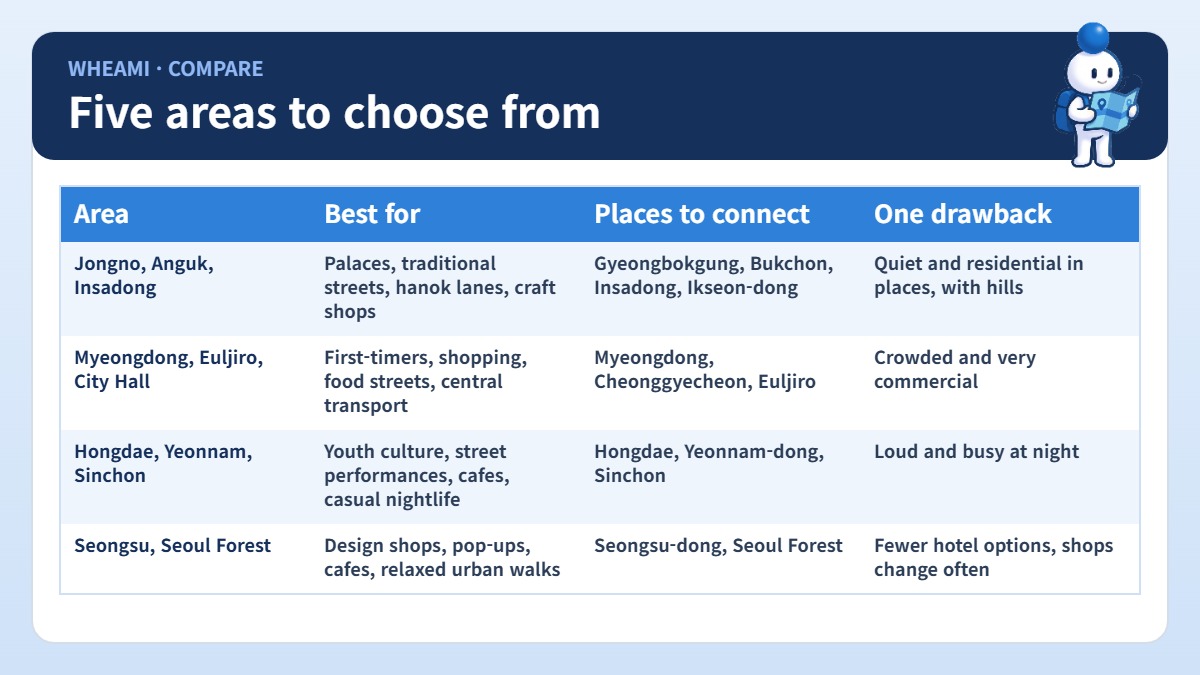
| Area | Best for | Places to connect | One drawback |
|---|---|---|---|
| Jongno, Anguk, Insadong | Palaces, traditional streets, hanok lanes, craft shops | Gyeongbokgung, Bukchon, Insadong, Ikseon-dong | Quiet and residential in places, with hills |
| Myeongdong, Euljiro, City Hall | First-timers, shopping, food streets, central transport | Myeongdong, Cheonggyecheon, Euljiro | Crowded and very commercial |
| Hongdae, Yeonnam, Sinchon | Youth culture, street performances, cafes, casual nightlife | Hongdae, Yeonnam-dong, Sinchon | Loud and busy at night |
| Seongsu, Seoul Forest | Design shops, pop-ups, cafes, relaxed urban walks | Seongsu-dong, Seoul Forest | Fewer hotel options, shops change often |
| Gangnam, Jamsil, Banpo | Shopping, large complexes, modern views, river parks | COEX, Starfield Library, Banpo Hangang Park, Jamsil | More spread out |
This is a selection guide. No neighborhood is objectively the best. Visit Seoul groups destinations by area, such as Gwanghwamun, Myeongdong, Hongdae, Itaewon, Gangnam, and Jamsil, which supports exploring Seoul as several distinct local areas instead of one tourist zone.
Jongno, Anguk and Insadong
The historic center around Jongno has Gyeongbokgung, Bukchon, and Insadong. Bukchon is a residential area, so check the current visitor guidance and keep quiet. Expect hills and steady walking.
Local tip: Choose one side of Seoul at a time. A neighborhood-hopping day can become mostly subway and transfer time. See our subway guide to plan transfers.
Myeongdong, Euljiro and City Hall
This central area is the easiest base for a first trip because it is well connected. It is crowded, so use it for convenience and short visits rather than a quiet day.
Hongdae, Yeonnam and Sinchon
Hongdae and nearby areas are known for youth culture, performances, and art. Check each venue before you count on a show or opening time.
Seongsu and Seoul Forest
Seongsu is a place to explore cafes, design shops, and pop-ups, with a relaxed walk in Seoul Forest. Specific stores and pop-ups change often, so treat them as optional, not permanent anchors.
Local tip: Do not plan Seongsu pop-ups as fixed stops. Look up what is open the week you go, and keep the day flexible.
Gangnam, Jamsil and Banpo
This is the choice for large shopping complexes, modern city views, and river parks. Distances are bigger, so check the station and exit before you go.
Where should you stay?
Do not choose a hotel only by the most famous district. Choose by transport access and the kind of trip. A central area reduces cross-city travel on a first trip, while staying farther east or west can suit a more focused plan. Visit and stay are separate decisions: a neighborhood can be great to visit without being the best base.
Local tip: Check the exact station exit and the walking route. “Nearby” on a map can still mean a long walk, a steep route, or a transfer.
Want a day-by-day plan?
If you prefer a schedule, see our Seoul in 3 days itinerary. This guide is for choosing where to spend your time.
Choose by what you want
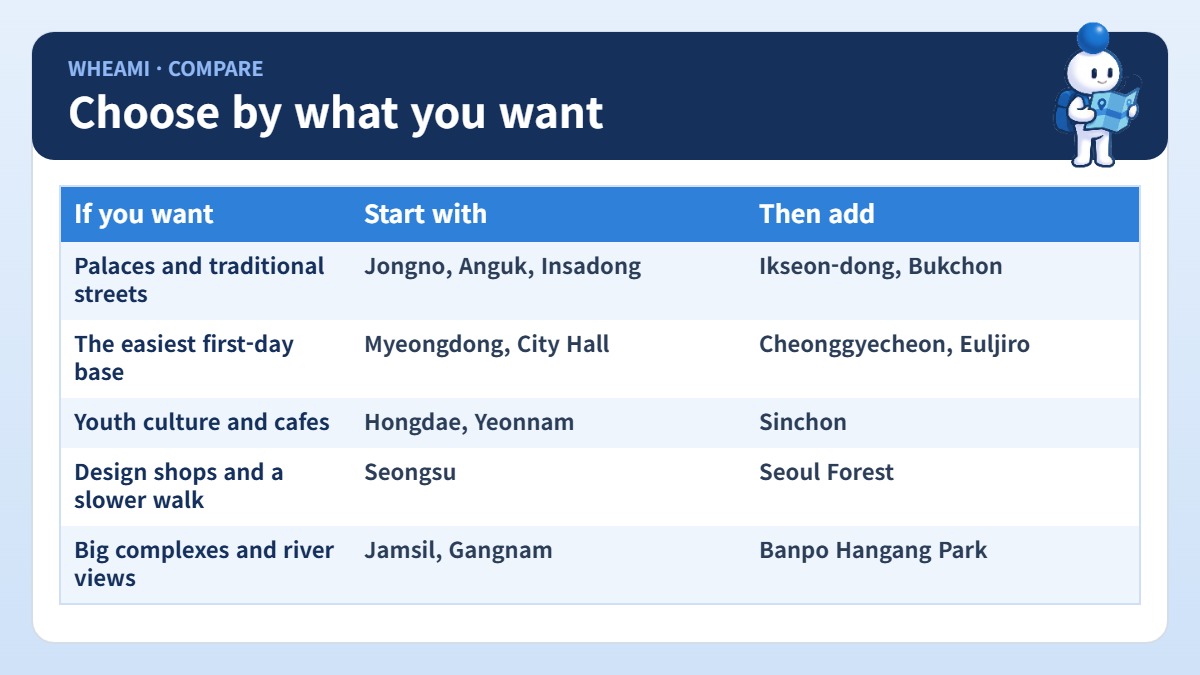
| If you want | Start with | Then add |
|---|---|---|
| Palaces and traditional streets | Jongno, Anguk, Insadong | Ikseon-dong, Bukchon (quietly) |
| The easiest first-day base | Myeongdong, City Hall | Cheonggyecheon, Euljiro |
| Youth culture and cafes | Hongdae, Yeonnam | Sinchon |
| Design shops and a slower walk | Seongsu | Seoul Forest |
| Big complexes and river views | Jamsil, Gangnam | Banpo Hangang Park |
What visitors report
These are individual traveler opinions, not a consensus.
- In a r/koreatravel discussion comparing Myeongdong, Hongdae, and Seongsu, visitors describe Myeongdong as centrally connected, Hongdae as younger and nightlife-oriented, and Seongsu as a place to explore cafes and pop-ups but with fewer hotel options.
- Another first-time visitor asked how to group Jongno, Bukchon, Insadong, and Ikseon, then Hongdae and Yeonnam, then Seongsu and Seoul Forest. The practical takeaway is to cluster nearby neighborhoods and not cover them all in one day.
Local tip: Pick one or two clusters a day and let the rest wait. Seoul is big enough that a cluster-hopping day turns into a transit day.
The local view of the city
Seoul’s official tourism material organizes the city by districts and walking routes, which backs the idea that Seoul is better explored as several distinct local areas. Locals also think in station-to-station terms: nearby on a map can still mean a long walk, a steep route, or a subway transfer. A neighborhood can look different by day and by evening, but check each venue before you count on a specific opening time or nightlife.
Local tip: Look up the exact station exit and the walking route before you leave, especially for hilly areas, and respect the quiet-hours guidance in residential areas such as Bukchon.

Two ways to build a trip
- Central base: reduces cross-city travel on a first trip.
- Focused base: staying farther east or west can suit a plan built around Hongdae or Seongsu.
Either works. The mistake is to pick a base by fame alone, so compare transport access and budget first.
FAQ
Which area is best for a first-time visitor?
Central areas such as Myeongdong or Jongno keep transport simple. The right choice depends on what you want to do.
Can I see all five areas in one trip?
Yes, in several days. Do not combine Jongno, Hongdae, and Seongsu into one tightly timed block.
Is Seongsu good for a first trip?
Many visitors enjoy it for cafes and design shops, but it has fewer hotel options and shops change often.