

Quick answer: Korean food that looks plant-based can still contain meat or seafood broth, fish sauce, salted seafood, or egg, and many restaurants have no separate vegetarian menu. Say your exact restriction before you order, ask about the broth and the sauces, and carry a printed card in Korean. For a serious allergy, do not rely on a menu name or a single verbal “yes.” This guide covers communication, not medical advice.

Vegetarian, vegan, halal, and allergy are not the same
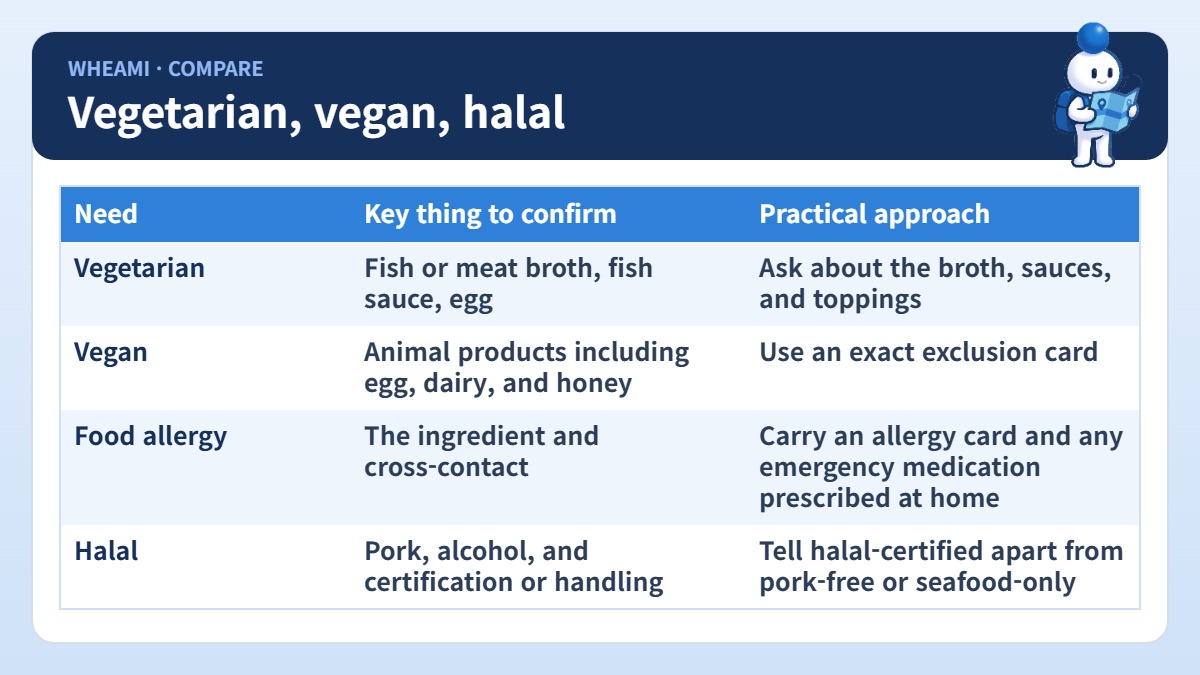
These needs overlap but are not interchangeable, so tell staff which one you mean. “No meat” is not the same as vegan, halal, or allergy-safe. “Vegetarian” can mean no visible meat to one diner and a strict exclusion of fish sauce, anchovy broth, shrimp paste, and shared cooking equipment to another. A dish can be meat-free without being vegetarian or vegan.
| Need | Key thing to confirm | Practical approach |
|---|---|---|
| Vegetarian | Fish or meat broth, fish sauce, egg | Ask about the broth, sauces, and toppings |
| Vegan | Animal products including egg, dairy, and honey | Use an exact exclusion card |
| Food allergy | The ingredient and cross-contact | Carry an allergy card and any emergency medication prescribed at home |
| Halal | Pork, alcohol, and certification or handling | Tell halal-certified apart from pork-free or seafood-only |
What the official guidance says
VISITKOREA’s vegetarian tips say Korean food is often prepared with meat or fish broth and that many restaurants have no separate vegetarian menu. It recommends telling staff clearly and naming the ingredients to leave out. It lists common pitfalls: bibimbap may include meat and egg, stews may use meat or fish broth, gimbap often includes ham or egg, and soups and porridge may use meat or seafood. Treat these as general patterns, not a guarantee about any single restaurant. KTO’s Muslim-friendly restaurant communication sheet asks restaurants to confirm halal availability, pork-derived ingredients, vegetarian and seafood options, and prayer space, and it separates pork-free from halal.
Local tip: Show your card before you order, not after the food arrives. Use large, simple type and name the exact ingredient and how severe the reaction is.
What to ask
- The broth: does it contain meat or fish?
- The kimchi and sauces: fish sauce, salted shrimp, or anchovy stock may be in them.
- Egg and other toppings that you cannot see.
- The grill, the oil, and the tongs, when shared equipment matters to you.
| Korean | Meaning |
|---|---|
| 저는 [재료] 알레르기가 있어요 | I am allergic to [ingredient] |
| 이 음식에 [재료]가 들어가나요? | Does this contain [ingredient]? |
| 육수에 고기나 생선이 들어가나요? | Does the broth contain meat or fish? |
| 같은 조리도구를 사용하나요? | Do you use the same cooking equipment? |
Replace the bracket with the ingredient in Korean, and have it checked by a Korean speaker if the reaction could be serious. For translation apps, see our essential apps guide.
Local tip: For a severe allergy, ask whether the kitchen can prevent cross-contact. If the staff cannot confirm, choose another option instead of assuming it is fine.

What visitors report
These are personal accounts, not a national guarantee.
- In April 2026 a parent whose child has severe dairy, egg, and peanut allergies plus a wheat sensitivity described using a printed allergy card and a translation app in Seoul and Suwon. They checked with staff, found hidden noodles in galbitang, and worried about shared tongs.
- In July 2026 a solo vegetarian traveler said it was hard to find vegetarian meals without preparation, used tofu and hostel food as a fallback, and found some good meals in Seoul and Andong.
- In June 2026 a vegetarian on a long solo trip described a plant-based bowl that unexpectedly included crab and fish roe, which shows that a label or the way a dish looks is not enough.
- In October 2026 a Korean commenter in a vegetarian itinerary thread explained that kimchi may contain fish sauce or salted shrimp and that vegetable soups may use anchovy stock. That is one local’s comment, not a universal ingredient statement.
Local tip: Treat a local’s explanation as a list of questions to ask, not as a claim that every restaurant uses the same recipe.
The local view
Local cooking relies on stocks and fermented seasonings that you cannot see on the plate, so an ingredient list on a menu rarely tells the whole story. The practical approach is to ask what you mean in specific terms and to pick restaurants that openly state vegetarian or vegan menus, then confirm the current menu and ingredients yourself. Eating from food stalls adds uncertainty, so see our traditional markets guide, and our restaurant etiquette guide covers how to call staff and order.
Common mistakes
- Assuming kimchi, soup, noodles, or vegetable side dishes are vegetarian.
- Treating “no meat” as the same as vegan, halal, or allergy-safe.
- Assuming a staff “no” covers cross-contact.
- Naming one dish or restaurant as safe for every allergy.
If you have a reaction, call 119 for an ambulance. Our emergency numbers guide explains who to call and what to say. Carry any emergency medication prescribed at home.

FAQ
Is Korean food vegetarian-friendly?
It can be, but broths and sauces often contain meat or seafood, and many restaurants have no separate menu.
Does kimchi contain fish sauce?
It may contain fish sauce or salted shrimp. Ask before you eat it.
Are vegetarian and halal meals the same?
No. Halal concerns pork, alcohol, and handling, and vegetarian concerns animal products. Say which one you need.
How do I explain a serious allergy?
Use a printed card in Korean that names the exact ingredient and severity, and confirm cross-contact in the kitchen.