

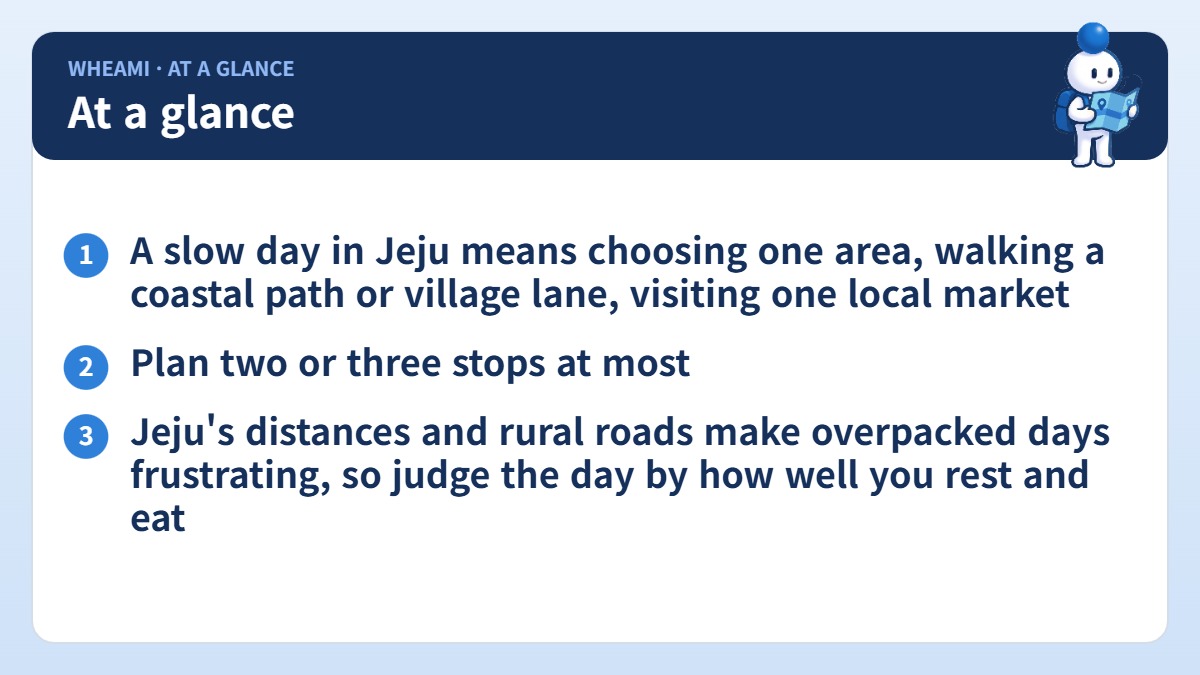
Quick answer: A slow day in Jeju means choosing one area, walking a coastal path or village lane, visiting one local market or cultural stop, eating nearby, and leaving time to sit by the sea. Plan two or three stops at most. Jeju’s distances and rural roads make overpacked days frustrating, so judge the day by how well you rest and eat, not by landmarks counted.
What slow travel means here
This is not a transport guide or an east versus west comparison. For buses, taxis, and tours, see our Jeju without a car guide, and for choosing a side, see Jeju East vs. West. Here the idea is simple: one area, one walk, one meal, one pause. Public transport works on some corridors, but check the actual route and frequency, and note that a taxi or car can be practical for scattered places. Slow travel does not mean every village is easy to reach.
Pick one area base
| Area | One-day rhythm | Best for | Caution |
|---|---|---|---|
| Jeju City and Naedo-dong | Local breakfast or a market stop, a coastal village walk, a cafe, a relaxed dinner | An accessible, low-transfer day | Check the walking links and bus or taxi availability |
| Aewol and Handam | A late breakfast, the 1.2 km coastal walk, a beach or cafe, sunset if the weather allows | Coastal scenery and gentle walking | Popular spots can be busy, and wind affects the walk |
| Jongdal-ri and the east coast | Village lanes and independent shops, a local meal, one nearby coast or viewpoint | A quiet village atmosphere | Do not assume frequent buses at every lane |
| Pyoseon and Seongeup | A beach or coastal road, a local meal, a village heritage stop | Traditional village context and coastal space | Respect residents, and experience schedules vary |
| A market-centered day | Dongmun Market, nearby old-town lanes, a rest at a cafe | Food and everyday local life | Crowds and store hours vary |
Visit Jeju’s lifestyle feature recommends everyday local experiences such as Dongmun Market, the village alleys of Jongdal-ri, independent bookstores, and quiet coastal roads. It also describes a slower walk around Naedo-dong and Aljakji with a quiet village feel near Jeju City, and presents the Handam Coastal Trail as a 1.2 km coastal walk near Aewol, a contained anchor and not an all-day cross-island route. Its Pyoseon area guide suggests short coastal walks, Seongeup Village, and local restaurants and cafes in the same area, and notes that experience schedules vary.
Local tip: Choose your accommodation and one main area before you pick individual cafes. Set two or three planned stops and leave the rest of the day open.

A rhythm for the day
- Morning: a late breakfast or a market stop, then a short walk.
- Afternoon: a meal near where you are, then one nearby cafe, beach, or cultural stop.
- Evening: stay put and watch the light, without a long transfer.
This is a framework, not a timetable, and the exact times depend on the weather and the shops. For the village stop, Seongeup is a living village, so keep noise low and do not enter private yards.
Car, bus, or taxi
If you do not drive, consider a local day tour or a taxi for one distant area, not a chain of remote stops. If you ride the bus, verify the route from the exact stop and check the next departure, not just the route number.
Local tip: A Jeju local contributor recommends KakaoMap over Google Maps for local routing and notes that rural bus coverage can be limited. That is one person’s practical view, not an official endorsement. Our essential apps guide covers map apps.

What visitors report
These are individual accounts, not universal time estimates.
- In June 2025 a family visitor described Jeju’s coast, hikes, waterfalls, and cafes, and warned that driving between distant areas can take longer than expected. One example was a 63 km drive that took about 90 minutes.
- In March 2026 a discussion about four nights without a car included a Korean resident’s detailed explanation of bus corridors and the difficulty of route variants and real-time information, alongside a visitor’s use of day tours and taxis for remote areas.
- In March 2026 a solo traveler staying in Jeju City enjoyed a southern day tour, relaxed near the hotel, and used a taxi for one separate trip, and noted that the weather can differ between the north and south of the island.
- In April 2026 a visitor without a driving licence asked whether Jeju was worth visiting. One respondent who used public transport said many places near main roads were accessible while isolated areas were harder.
The local view
A Korean resident who has visited Jeju repeatedly by public transport described circular coastal bus corridors and the need to check the Jeju Bus Information System, because route numbers and stop-level details can be confusing. Routes and frequencies must be rechecked on your date. Jeju’s villages are lived-in communities, not open-air theme parks, and Visit Jeju asks visitors to explore Seongeup quietly because residents live there.
Local tip: Try one local market or neighborhood restaurant instead of crossing the island for a viral cafe. Keep a weather-flexible backup, since wind and rain change coastal walks.

FAQ
Which area is best for a slow day?
It depends on what you want. Jeju City and Aewol are the easiest to combine with low transfers.
Is Aewol good for a relaxed day?
Yes, for coastal scenery and a gentle walk, though popular spots can be busy.
How long is the Handam Coastal Trail?
Visit Jeju presents it as a 1.2 km coastal walk.
Can I reach villages by bus?
Some, but not all. Check the route and the return before you go.